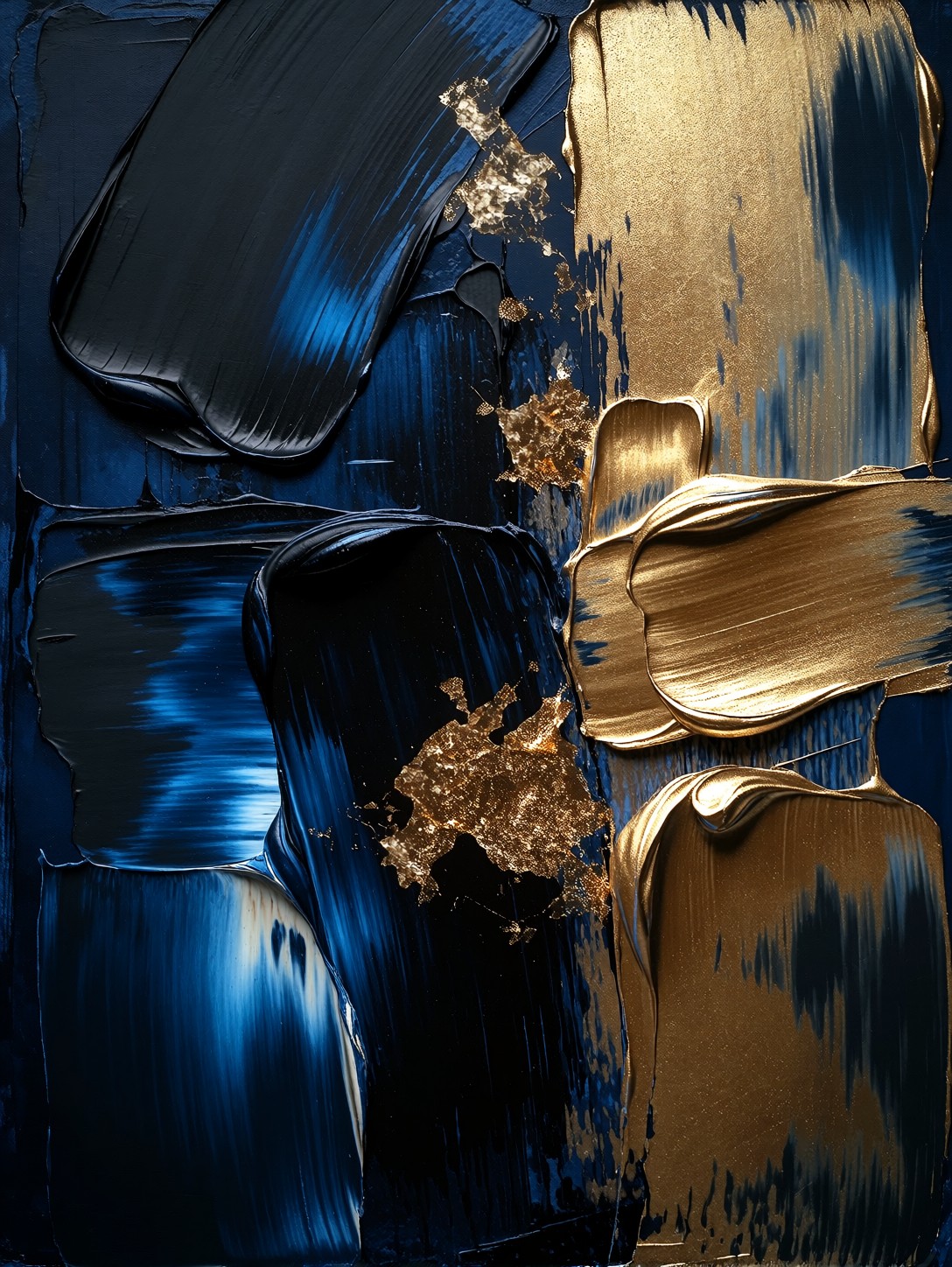
The Tactile Weight of Gold and Shadow: How This Impasto Canvas Works
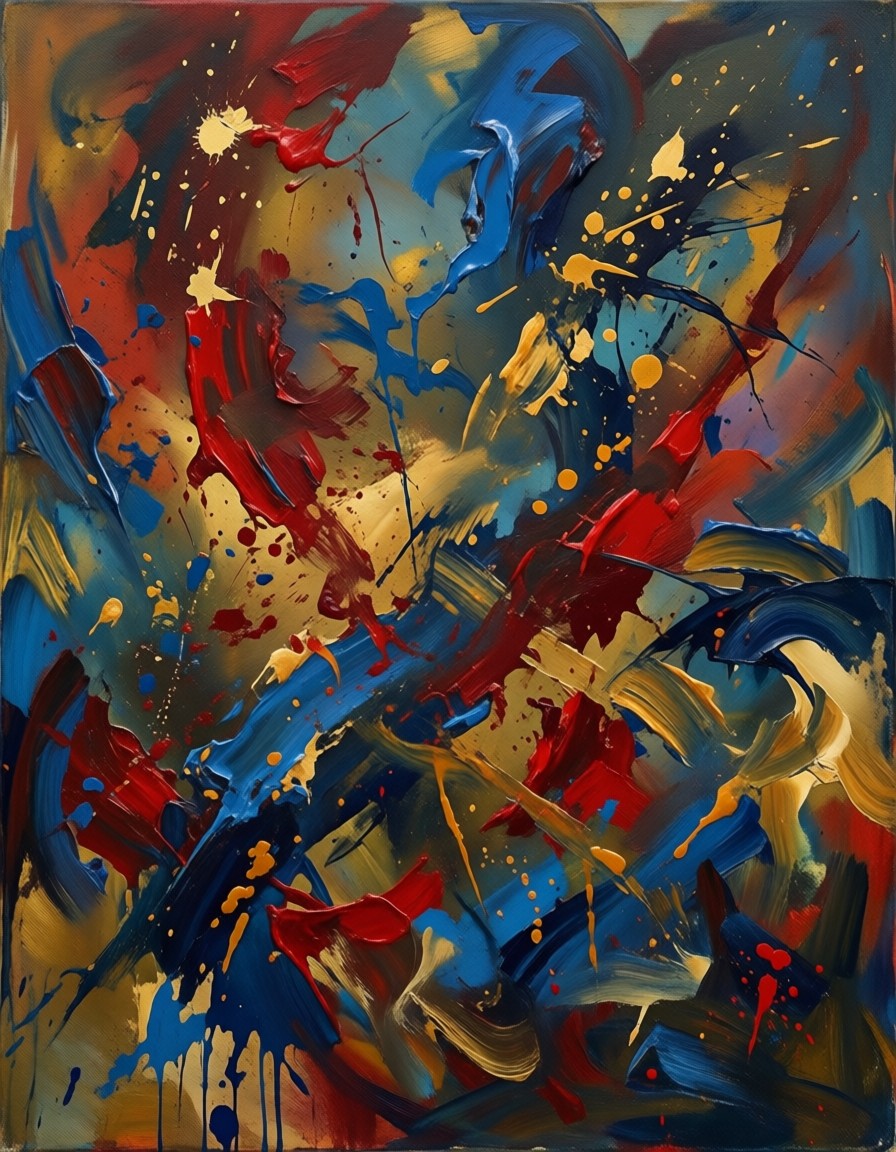
The most immediately striking element here is the physical depth of the paint itself — heavy impasto with raised layers that cast their own tiny shadows under gallery lighting. Proxima Aurelia 2 handles this kind of material specificity unusually well: the palette knife cuts read as actual gouges in the surface, the gold leaf flakes catch directional light the way real 24-karat foil would, and the matte black passages absorb light rather than reflecting it, creating genuine tonal contrast rather than just colour difference. The three-palette restriction — navy, gold, black — keeps the composition from dissolving into noise, giving the aggressive sweeping strokes a disciplined structure underneath the raw energy.
Where a Canvas Like This Actually Goes
Interior design mockups, luxury brand campaign visuals, and album cover art all benefit from this kind of high-contrast, texture-forward abstract. The gallery lighting baked into the prompt means the output already looks like a photograph of a physical painting on a wall — no compositing needed for a realistic "hanging in a space" effect.
For print reproduction at poster size, generate at the highest resolution the model supports and keep the aspect ratio at 1:1 or 4:5. The impasto detail is dense enough that it holds up well at large scale; stretching it to ultra-wide 16:9 will flatten the vertical stroke energy and make the gold flakes read as scattered specks rather than deliberate accents.
Settings for Proxima Aurelia 2 — Letting the Texture Breathe
Proxima Aurelia 2 sits on the Flux Schnell architecture, so standard Flux parameter logic applies. The key challenge here is preserving the micro-detail of the impasto relief without the model smoothing it into a flat colour field.
- CFG / Guidance:
3.0–3.5— at 4.0+ the gold flakes start to clip into pure white and lose their dimensional sparkle - Steps: 25–30 — the paint relief needs enough denoising passes to resolve individual knife cuts; 12 steps will produce a decent composition but flatten the surface
- Resolution:
1344×1344(1:1) for a square canvas feel, or1080×1350(4:5) for a portrait orientation that emphasises the vertical sweep of the strokes
The model description notes that Aurelia 2 creates "breathtaking masterpieces from even the simplest prompts" — but this prompt is already detail-rich. Resist the urge to add more adjectives; the specificity of "palette knife cuts" and "gold leaf flakes catching the light" is doing more work than a string of quality tags ever could.
Five Directions to Push the Canvas Further
Targeted Variations for This Impasto Composition
- Swap the palette: Replace "deep navy blue, burnished gold, and matte black" with "crimson oxide, raw silver, and charcoal grey" — the metallic shift from gold to silver changes the temperature from warm-luxury to cold-industrial without altering the technique
- Macro close-up: Add "extreme close-up, filling the frame with a single area of the canvas where gold leaf flakes cluster over a ridge of dried impasto" — the composition becomes almost geological, like a satellite view of a mineral deposit
- Backlit instead of front-lit: Change "dramatic studio gallery directional lighting" to "strong backlight, paint edges glowing translucent at the ridge, deep shadow in the valleys" — the impasto becomes a relief sculpture lit from behind, dramatically different mood
- Introduce a figure: Add "a faint silhouette of a standing figure barely visible beneath the topmost layer of paint, as if the abstraction is concealing a portrait" — adds narrative tension without breaking the abstract framework
- Wet-on-wet shift: Replace "heavy impasto technique with thick, raised layers" with "wet-on-wet blending, smooth gradients with no visible brush direction, almost liquid" — same palette, completely opposite tactile experience; the gold becomes a wash rather than a flake
Two Prompts Ready to Generate
Both examples apply one of the variations above and are tuned for Proxima Aurelia 2 at the settings recommended here.
Variation: backlit impasto — the paint relief becomes a shadow-play sculpture, gold edges glow while valleys fall into darkness
Abstract Expressionism, fine art painting. Massive textured canvas with aggressive sweeping strokes of deep navy blue, burnished gold, and matte black paint. Heavy impasto, thick raised layers of dried paint, visible palette knife cuts, fine gold leaf flakes. Strong backlight source, paint edges glowing translucent at the ridges, deep shadow pooling in the valleys between strokes. Rich tactile relief, high contrast, gallery aesthetic, 8k resolution
Variation: concealed figure — a faint silhouette emerges from beneath the abstraction, adding narrative weight to the raw gesture
Abstract Expressionism, fine art painting. Massive textured canvas with aggressive sweeping strokes of deep navy blue, burnished gold, and matte black. Heavy impasto, palette knife cuts, fine gold leaf flakes catching light. A faint silhouette of a standing figure barely visible beneath the topmost paint layer, as if the abstraction conceals a portrait. Dramatic gallery directional lighting, subtle shadows across the thick relief, high contrast, 8k
More Abstract Expressions Worth Exploring
These prompts work in the same visual register — bold colour, strong compositional energy, and a focus on how paint and light interact on a surface: