
Where Gilded Glow Meets Steel Shavings
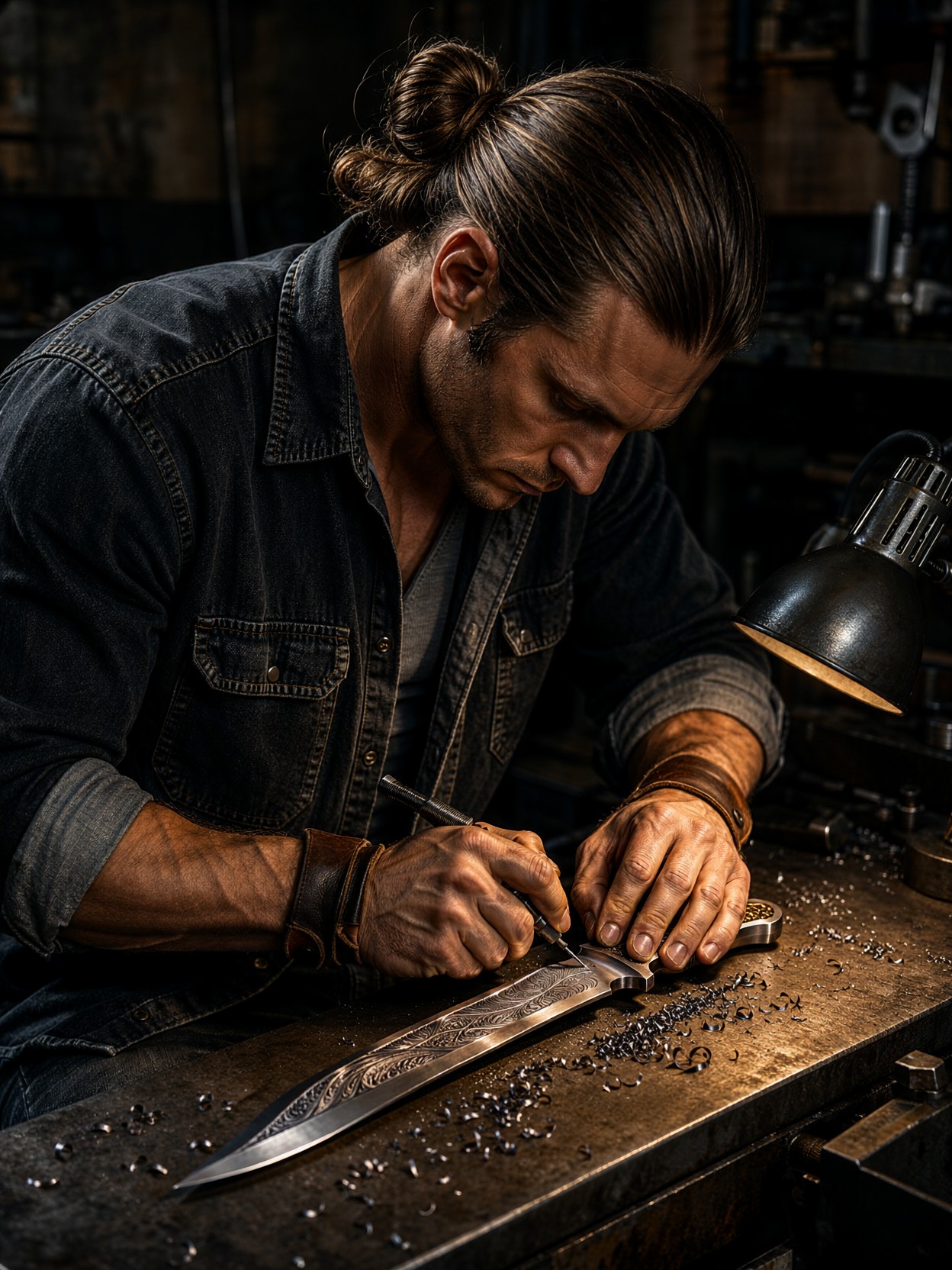
A celestial-fantasy LoRA layered at full weight over a gritty knife-engraving scene is the kind of collision that produces something neither style could achieve alone. The GPT style LoRA injects iridescent shimmer into the steel blade's surface and wraps the amber desk-lamp glow in a soft, almost sacred cinematic haze — while the prompt's own language (metal grain, skin pores, fabric texture, steel shavings) anchors everything in tactile, working-class reality. The result is a craftsman who looks like he's been lit by a Renaissance master, not a shop lamp.
Qwen 2.1's native 2K output and its particular strength in lifelike portrait lighting handle the contrast between the warm focal beam and the deep surrounding shadows with unusual grace, keeping skin pores and denim weave visible even in the dimmest areas of the frame.
Workshop Portraits That Double as Brand Identity
Custom knife makers, small-batch jewelers, and artisan tool brands need hero images that feel both premium and hands-on. This prompt delivers exactly that: a face you can trust, hands that look like they've actually done the work, and a level of surface detail that sells the craft. It works well as a website hero, a product-page backdrop, or a print for a maker's studio wall.
For the tightest control over the 50mm-equivalent framing, generate at 1080×1350 (4:5) — the vertical ratio gives the lamp beam room to fall naturally downward without cropping the workbench. A cinematic 16:9 crop at 1536×864 also works if you want to pull the background further into shadow and let the subject dominate the left third of the frame.
Qwen 2.1 Settings for Maximum Texture Fidelity
Qwen 2.1 outputs natively at 2K, which means you're already getting significantly more pixel data than most image models at the same nominal resolution. The model's strength in fine detail and lifelike portrait lighting makes it a natural fit for a prompt that explicitly calls out metal grain, skin pores, and fabric weave.
- CFG / Guidance:
4.0–5.0— this prompt is heavily descriptive; a slightly higher guidance value helps the model honour every texture callout without drifting into abstraction. Start at 4.5. - Steps: 30 — the number of texture layers here (denim weave, leather grain, steel shavings, skin pores) benefits from the extra denoising passes. 12 steps will lose the fine metal detail.
- Resolution:
1080×1350(4:5) for the portrait framing described in the prompt;1536×864(16:9) for a cinematic wide variant
Qwen 2.1's integrated typography capability is irrelevant here, but its crispness at 2K means the steel shavings on the workbench will render as individually distinguishable fragments rather than a blurred texture smear — a detail that makes or breaks the "real workshop" feel.
Layering the GPT Style LoRA at Full Weight
The GPT style LoRA is set at weight 100, which means it will be the dominant visual influence. In practice, that translates to: iridescent colour fringing on every metallic surface, a soft cinematic glow around the lamp beam, and a slightly dreamlike quality to the shadow areas that wouldn't appear in a purely documentary shot.
- At weight 100 (as specified): the craftsman reads as a modern artisan saint — the amber light has a halo quality, the steel blade catches faint iridescent highlights, and the shadows feel painterly rather than photographic. Use this if you want the image to feel elevated and almost mythic.
- At weight 50–70: the iridescent shimmer becomes subtle, the glow softens, and the image lands closer to a National Geographic workshop feature. Good for product photography where the craft itself needs to be the hero.
- At weight 25–40: nearly invisible influence — a very faint warm colour cast on the highlights. Use this if you want the LoRA to act as a gentle colour-grading pass rather than a full style shift.
Five Ways to Shift This Craftsman Scene
5 Targeted Variations for the Workshop Portrait
- Swap the craft: Replace "engrave intricate patterns onto a custom steel knife blade" with "set a ruby bearing into a pocket watch movement using a jeweller's loupe and tweezers" — the scene becomes quieter, more precise, and the GPT style LoRA's iridescent shimmer reads naturally on tiny gemstones and polished gears.
- Invert the colour temperature: Change "warm amber beam" to "cold blue-green beam" and "rich, moody shadows" to "deep indigo shadows" — the same composition becomes clinical and forensic, closer to a crime-scene photograph than a cosy workshop. The LoRA's cinematic glow will make the blue light feel almost bioluminescent.
- Drop the LoRA entirely: Set GPT style weight to 0 and add "shot on Canon EOS R5, natural tungsten light, no colour grading, documentary style" — you get a pure photojournalistic workshop image with zero fantasy influence. The 2K native resolution of Qwen 2.1 still delivers the texture detail.
- Add a second figure: Insert "a younger apprentice stands to the right, watching intently, hands clasped, wearing a similar denim shirt" — the composition becomes a two-shot, the lamp light now illuminates two sets of hands, and the GPT style LoRA adds a shared golden glow that reads almost like a Renaissance teacher-and-student painting.
- Shift the era: Replace "vintage workshop" with "brutalist concrete studio, exposed rebar, fluorescent tube light overhead" and change the lamp to "a bare LED panel on a stand" — the craftsman becomes contemporary, the denim shirt reads as fashion rather than workwear, and the LoRA's iridescent quality plays off the cold concrete more dramatically.
Two Prompts Ready to Generate
Both examples apply variations from the list above and are tuned for Qwen 2.1 at 30 steps, CFG 4.5, with the GPT style LoRA at its original weight of 100.
Variation 1 applied: knife engraving swapped for watchmaking, amber light swapped for cold emerald banker's lamp — the iridescent LoRA now plays off tiny gemstones and polished gears instead of steel
Realism, atmospheric portrait. Eye-level waist-up shot of a focused watchmaker at a brass-plate workbench in a dimly lit Victorian workshop, using a jeweller's loupe and tweezers to set a ruby bearing into a pocket watch movement. Bent forward, completely absorbed. Dark wool vest over white linen shirt, sleeves rolled to elbow, leather finger cots. Short cropped hair, wire-frame spectacles. A single green-shaded banker's lamp casts a cold emerald beam onto the watch face and scattered gears, background in deep charcoal shadow. Canon EOS R5, 85mm f/1.4, rich contrast, extreme clarity on metal polish, fabric weave, glass reflection, photorealistic, 8k.
Variation 2 applied: same knife-engraving subject, warm amber replaced with cold blue-green light, shadows shifted to deep indigo — the GPT style LoRA makes the blue beam feel almost bioluminescent against the dark
Realism, atmospheric industrial portrait. Eye-level waist-up shot of a focused craftsman at a heavy iron workbench in a dimly lit vintage workshop, engraving intricate patterns onto a custom steel knife blade with precision tools. Bent over, completely engrossed. Unbuttoned dark denim work shirt, rolled-up sleeves over grey top, muscular forearms, leather wrist guards. Long thick hair in a low neat bun. A single desk lamp casts a cold blue-green beam onto his hands and the metal blade, steel shavings on the table, background in deep indigo shadow. Canon EOS R5, 50mm f/1.2, rich contrast, extreme clarity on metal grain, skin pores, fabric texture, photorealistic, 8k.
More Atmospheric Portraits in This Vein
These prompts explore the same territory of moody, single-source lighting and rich surface detail, each from a different subject and cultural angle: