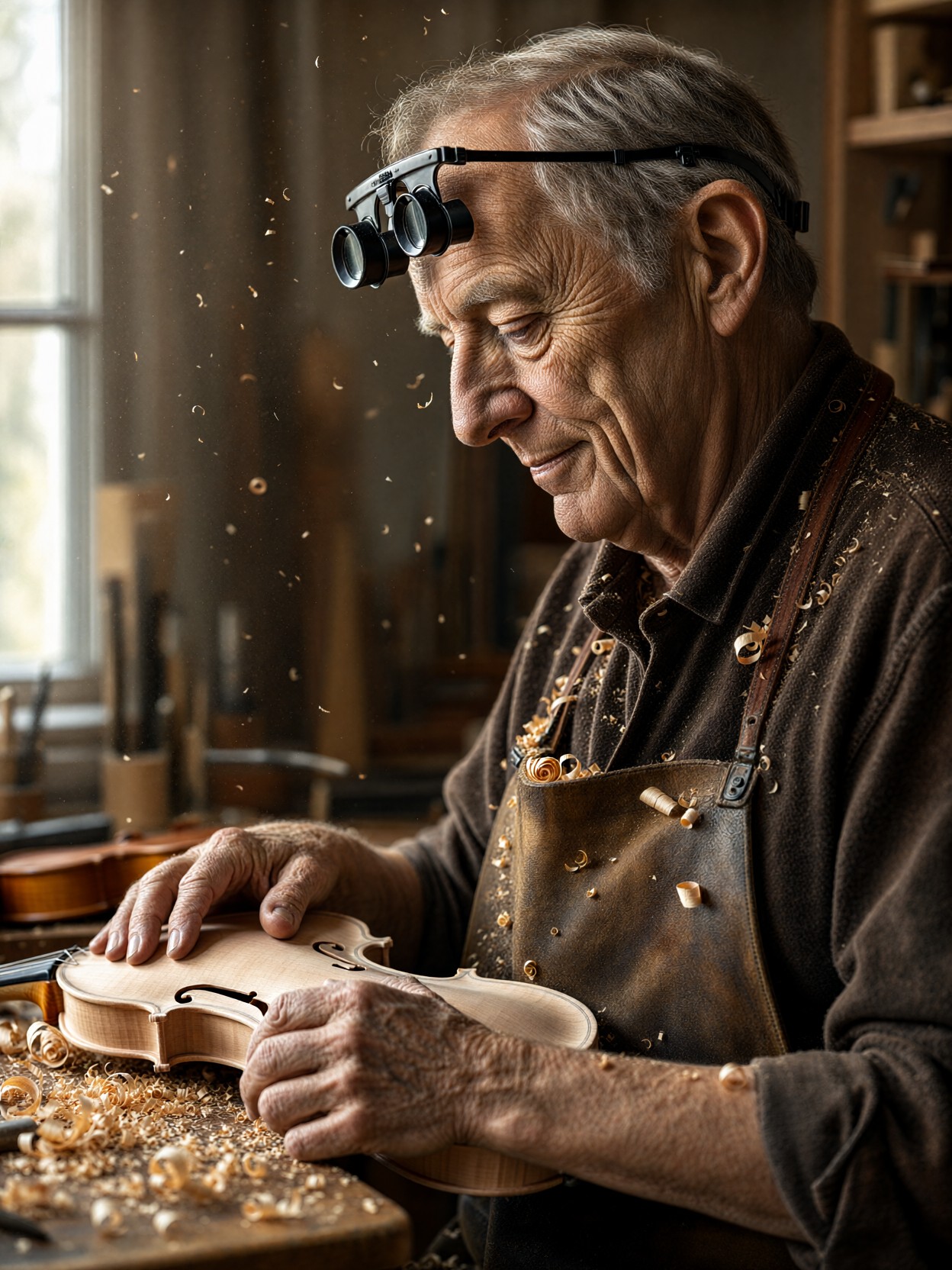
Sawdust in the Light: Why This Luthier Portrait Feels Real
The floating sawdust is the detail that sells everything. Soft window light from the left catches those suspended particles mid-air, and suddenly the workshop breathes — it stops being a set and becomes a place where someone has worked for forty years. Qwen 2.1 handles this beautifully: its native 2K output resolves wood shavings, leather grain, and skin texture without smearing, and its portrait lighting reads as genuinely directional rather than generic.
The lowered gaze and pushed-up loupe do the emotional work. Combined with the half-carved violin under weathered hands, the image becomes a portrait of craft itself — quiet, focused, unhurried. Warm amber against muted walnut brown keeps the palette unified and painterly.
Where This Portrait Earns Its Keep
Fine art portraiture like this belongs in editorial spreads, craft and artisan brand storytelling, gallery prints, and music-adjacent marketing — violin makers, conservatories, instrument shops. The three-quarter profile and shallow depth of field also make it ideal for large-format vertical display.
Stick to 3:4 or 4:5 portrait orientation (e.g. 1080×1440). Landscape crops fight the composition: the window light source and the violin both want vertical room. Avoid pushing the lens too wide — the 85mm compression is doing real work here.
Dialing In Qwen 2.1 for Photorealistic Portraits
Qwen 2.1 rewards restraint — the model's native detail handling means you rarely need to over-specify texture keywords.
- CFG / guidance:
3.0–3.5— keeps skin natural; higher values harden wrinkles into caricature - Steps: 30 for final quality; 12 for fast composition previews
- Resolution:
1080×1440(3:4) or push to1664×2208for print-grade 2K output
Qwen 2.1's strength is lifelike directional lighting — trust the phrase "soft window light from the left" and let the model build the falloff. Adding extra lighting descriptors often fights the natural look.
Bonus: if you ever want a workshop sign or instrument label in frame, Qwen's crisp typography rendering will handle the text cleanly — just describe it explicitly.
Five Ways to Reshape the Craftsman Portrait
5 Targeted Variations on the Luthier Prompt
- Shift the craft: Swap "violin body" for "guitar neck" or "cello scroll" — same workshop soul, different silhouette and tool set
- Cool the light: Change "warm amber tones" to "pale blue winter light, snow visible through the window" — the mood turns from nostalgic to contemplative and solitary
- Change the era: Replace "Canon R5" with "shot on 1950s medium format film, Kodak Portra" — grain and softer micro-contrast give a documentary archive feel
- Add a moment of connection: Change "gaze lowered" to "looking directly at the camera, faint knowing smile" — transforms the portrait from observed to confrontational
- Go environmental: Add "wide shot, full workshop visible, walls of hanging tools" — trades intimacy for storytelling context, best at 16:9
Two Prompts Ready to Generate
Two variations above, applied directly — both tuned for Qwen 2.1 at the settings recommended here.
Variation: winter light reframe — the warm amber nostalgia becomes pale, contemplative solitude
Portrait, fine art photography. Close-up three-quarter profile of an elderly luthier in his workshop, weathered hands resting on a half-carved violin body, curled wood shavings scattered across his worn leather apron. Pale blue winter light from a frosted window, snow visible outside, dust motes drifting in the air, cool muted tones against walnut browns. Gaze lowered, focused and serene, magnifying loupe on forehead. Canon R5, 85mm f/1.2, shallow depth of field, photorealistic, highly detailed, 8k
Variation: direct gaze and film era — the subject meets the camera while vintage medium format softens the render
Portrait, fine art photography. Close-up three-quarter profile of an elderly luthier in his workshop, weathered hands on a half-carved violin body, wood shavings on his leather apron. Soft window light from the left, warm amber tones, sawdust floating in the air. He looks directly at the camera with a faint knowing smile, magnifying loupe pushed up on his forehead. Shot on 1950s medium format film, Kodak Portra, subtle grain, richly textured skin and wood grain, photorealistic, 8k
More Portraits Built on Light and Character
These prompts explore similar territory — natural light, strong character presence, and photoreal finish — from entirely different angles:


