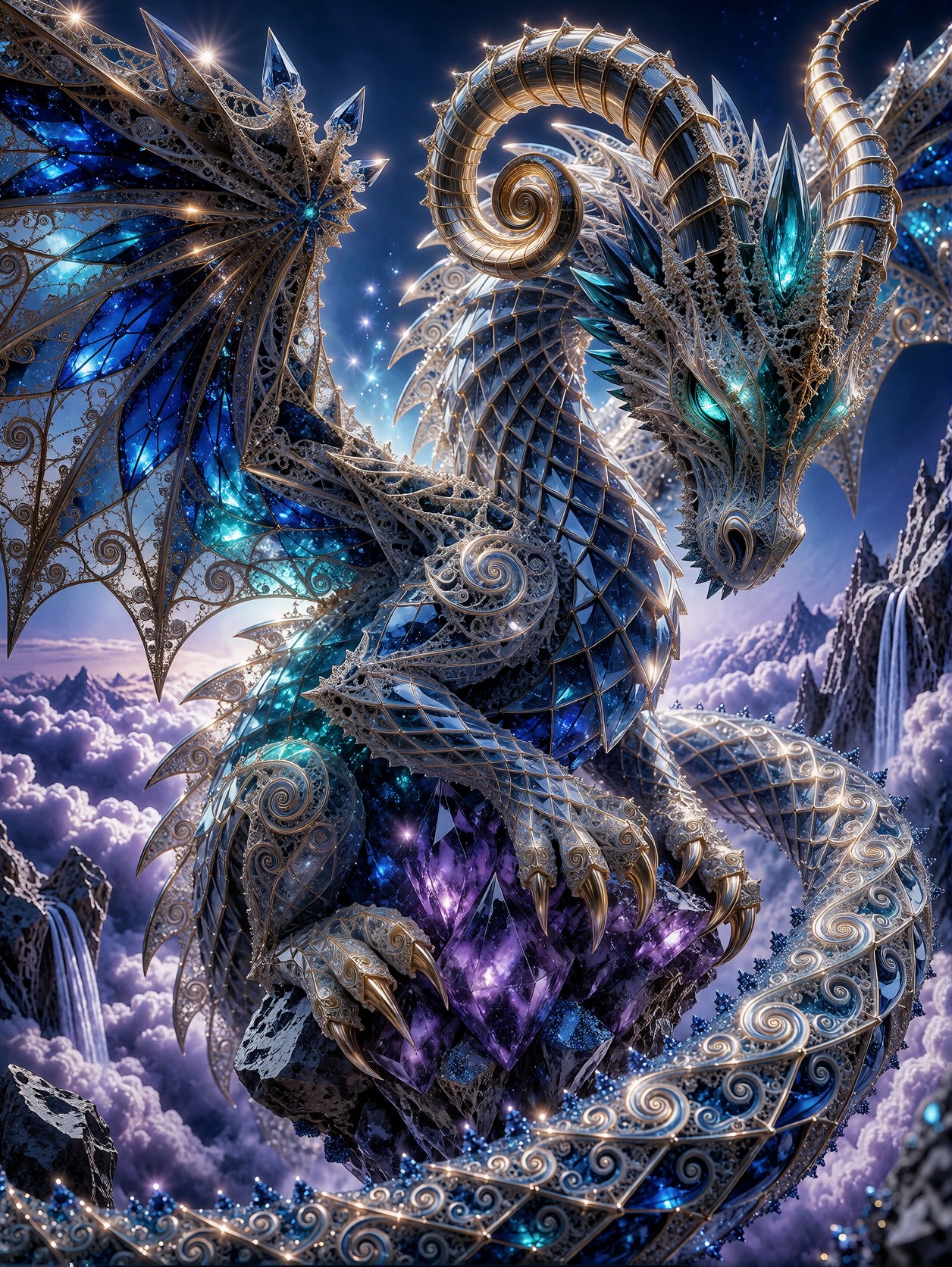


Recursive Scales and Frozen Lightning: Anatomy of a Fractal Dragon
The most audacious idea here isn't the dragon — it's that every scale is a smaller copy of the dragon itself. Each translucent plate contains miniature spirals echoing the armored body, and the wings unfold into recursive patterns that read as both frozen lightning and stained glass. Proxima Aurelia 2 thrives on this kind of nested description: it translates "endlessly branching crystalline fractals" into genuinely self-similar geometry rather than generic sparkle.
The color script does the rest of the work. Deep sapphire and luminous violet establish the atmosphere, turquoise eyes become the single focal glow, and golden logarithmic-spiral horns pull the eye upward. Waterfalls vanishing into violet clouds below add vertigo — this is a composition built for breathtaking scale 🐉
Key Art, Wallpapers, and Print-Ready Fantasy Posters
Vertical fantasy compositions like this one land naturally in game key art, phone and desktop wallpapers, TCG card art, and large-format posters. The strong vertical elements — coiled body, floating mountain, falling water — reward a tall canvas.
Use 3:4 portrait (1080×1440) to preserve the full vertical drop from peak to clouds. A 16:9 crop works for cinematic banners, but you'll lose the waterfall depth. Skip this one for square thumbnails — the recursive detail needs vertical breathing room.
Tuning Proxima Aurelia 2 for Fractal Detail
Aurelia 2 is built for rich visual storytelling from minimal prompting — but this prompt is dense, so the model needs room to resolve every nested spiral without turning facets into noise.
- CFG / Guidance:
3.0–3.5— high enough to hold the fractal structure, low enough to avoid clipped highlights on the crystal - Steps: 30 for maximum quality — recursion and stained-glass wing detail degrade noticeably at 12 steps; use 12 only for composition previews
- Resolution:
1080×1440(3:4) — push to1344×1792if you want print-sharp scale edges
Because Aurelia 2 rewards aesthetics-first generation, resist the urge to raise guidance above 4.0 — the model renders dramatic depth better through its own composition intelligence than through heavy prompt pressure.
Layering the LoRAs
- GPT style at
0.80— the dominant voice here: gilded opulence, iridescent color, and mythic scale. This is the LoRA that makes the golden spirals and cinematic glow sing - Midjourney-Style Rendering at
0.45— polishes the cinematic lighting and adds that signature dramatic depth without fighting the base style - Jima Illustration Style at
0.45— softens edges toward an illustrated, anime-adjacent finish. Keep it under0.5or the crystalline facets lose their sharpness
GPT style at 80 leads, and the two 45-weight LoRAs act as texture layers. If the result looks too painterly, drop Jima to 0.25; if it feels too photographic for your taste, raise it to 0.60 and watch the whole image drift toward illustration.
Five Directions to Take the Fractal Dragon Further
Targeted Variations for This Crystal Dragon Prompt
- Swap the palette: Replace "deep sapphire, luminous violet, turquoise and rich gold" with "molten crimson, obsidian black, molten gold" — the dragon shifts from celestial to volcanic, and the violet clouds become ash
- Change the geometry: Replace "crystalline fractals" with "organic fractals like fern fronds and nautilus shells" — a living dragon grown from botanical recursion instead of mineral precision
- Flip the scale story: Change "floating mountain" to "a shattered cathedral spire" — architecture instead of geology, with stained-glass shards echoing the wing patterns
- Go intimate: Add "close-up portrait, head and shoulders, shallow depth of field" — trade the breathtaking scale for a study of turquoise eyes and spiral horns, ideal for avatars and card art
- Time shift: Replace "cinematic lighting" with "bioluminescent night, aurora overhead" — the sapphire and violet palette deepens, and the crystal fractals become the primary light source
Two Prompts Ready to Generate
Both examples below apply variations from the list above, tuned for Proxima Aurelia 2 at the recommended settings.
Variation: volcanic palette — sapphire and violet give way to molten crimson and obsidian, turning the celestial dragon into a creature of fire
Fractal fantasy, intricate crystal art, cinematic lighting. A majestic dragon coiled around a floating mountain of obsidian and molten gold, its entire body formed from endlessly branching crystalline fractals glowing with inner fire. Each translucent scale contains miniature spirals repeating its armored shape; wings unfold into recursive patterns like frozen lava and embered glass. Sweeping horns curl into golden logarithmic spirals, molten orange eyes glow beneath a crown of crystal spires. Far below, rivers of fire disappear into ash clouds. Deep crimson, obsidian black, molten gold, sharp facets, dramatic depth, breathtaking scale, no text, no watermark.
Variation: intimate portrait — the epic scene compresses into a close-up study of the dragon's head, ideal for avatars and card art
Fractal fantasy crystal art, cinematic lighting, close-up portrait of a dragon's head and shoulders, its face formed from endlessly branching translucent crystalline fractals, each scale containing miniature spirals echoing its armored form. Enormous horns curl into golden logarithmic spirals, luminous turquoise eyes glowing beneath a crown of tiny crystal spires, wings hinted as recursive stained-glass patterns behind. Shallow depth of field, deep sapphire and violet bokeh, sparkling mineral dust, sharp facets, no text, no watermark, 3:4 portrait.
More Fractal Fantasy From the Same Family
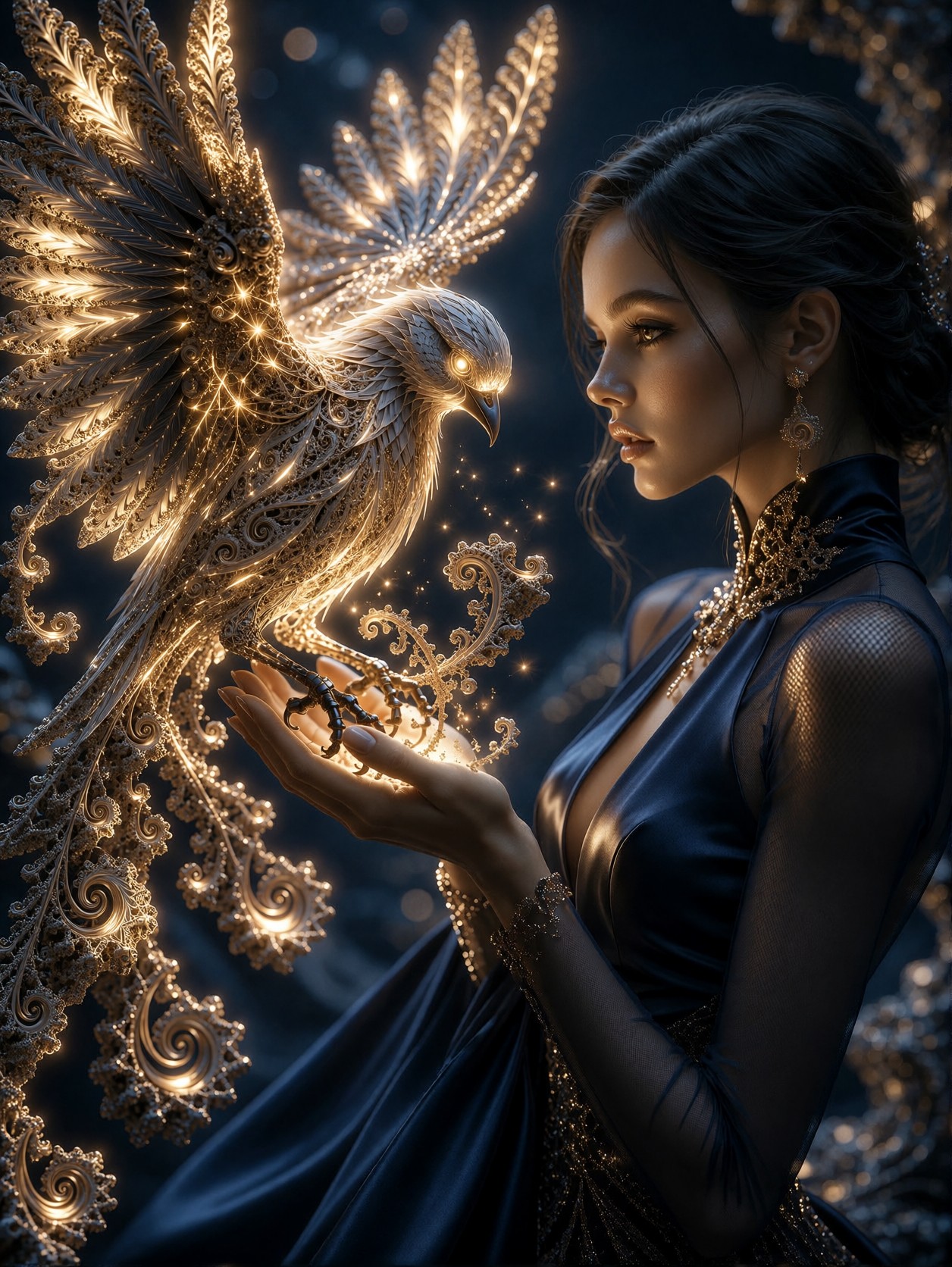
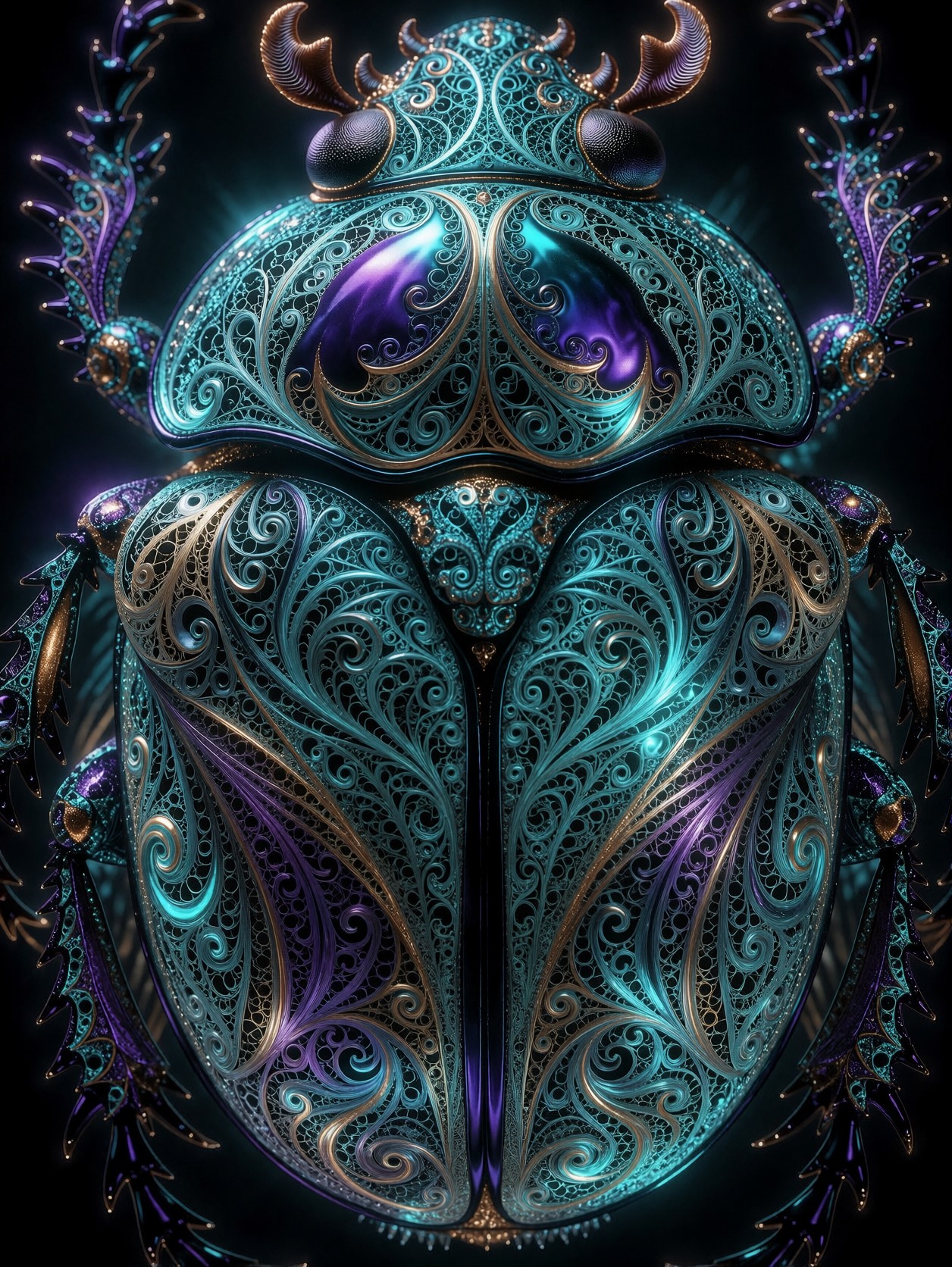
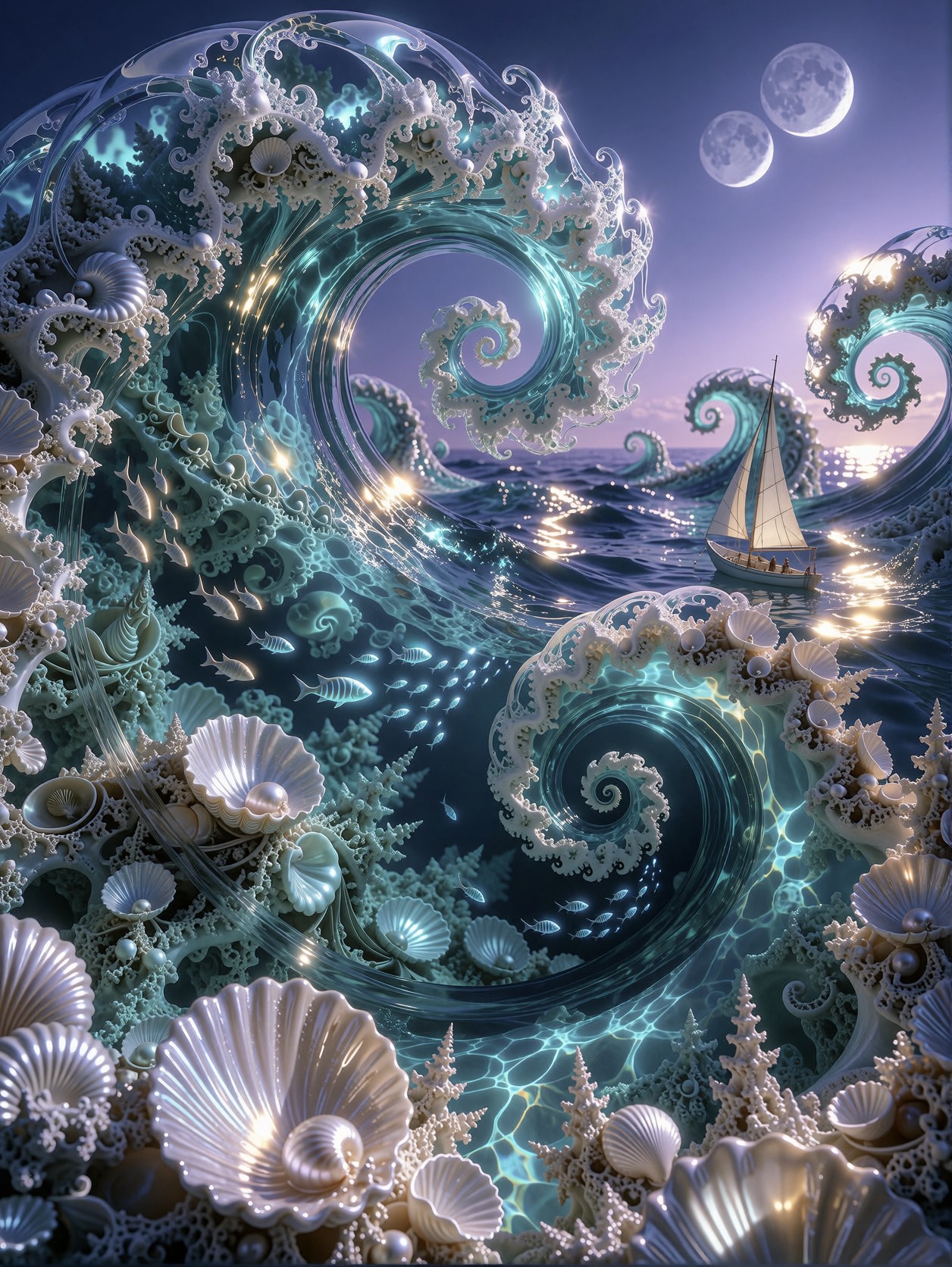
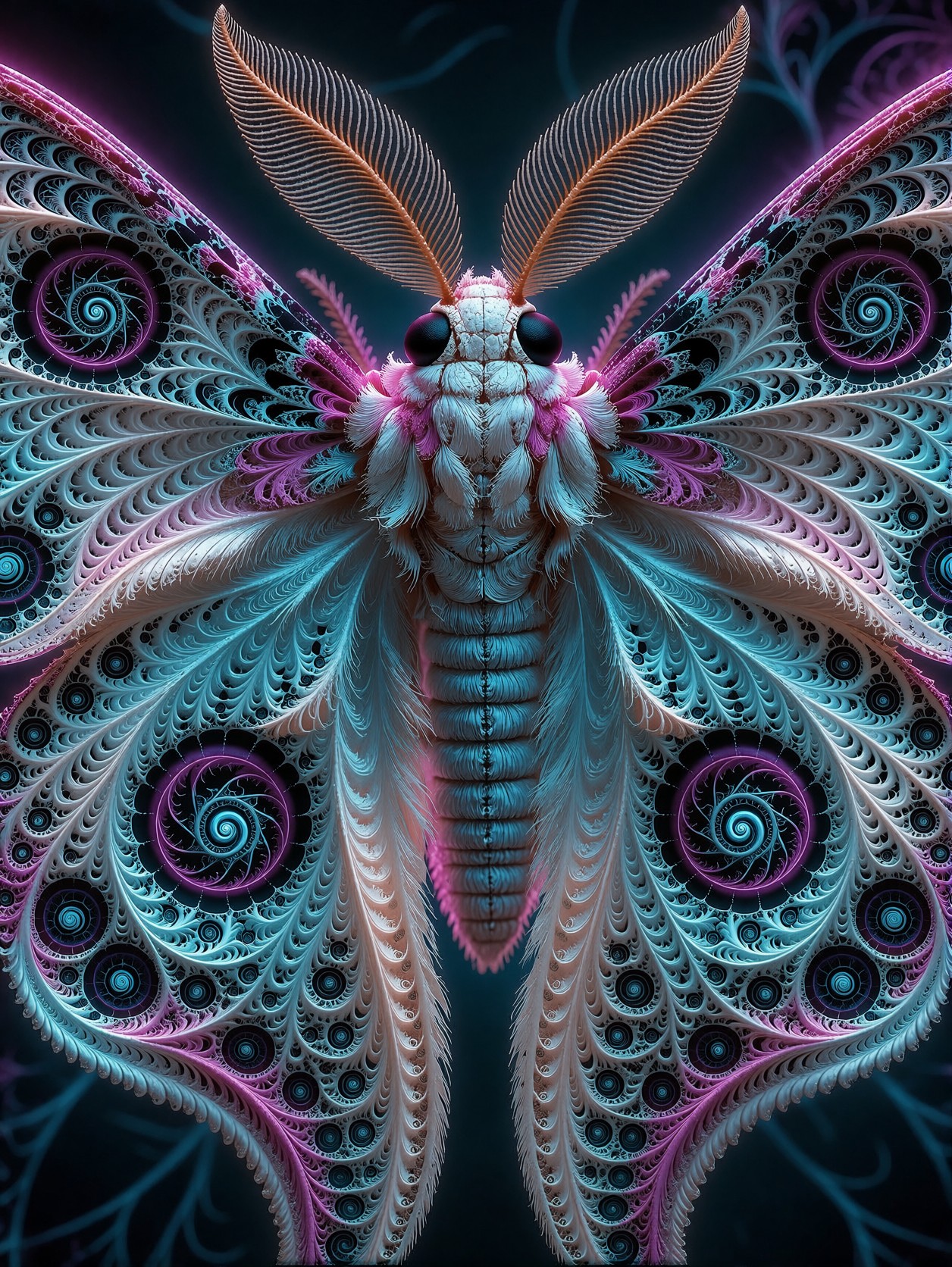
These prompts share the recursion-and-glow DNA — celestial birds, filigree scarabs, and spiral oceans all built with the same fractal logic: