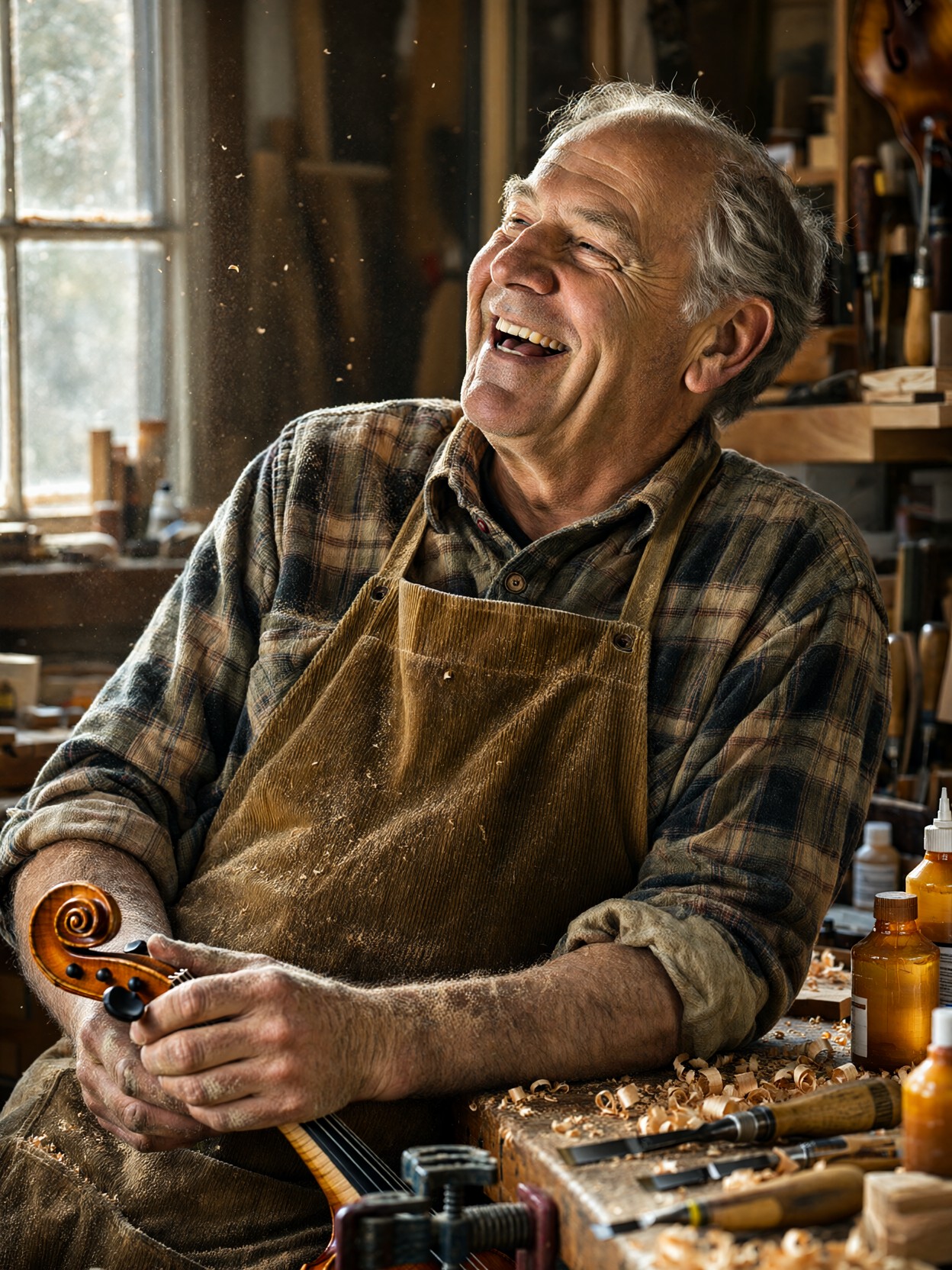
Sawdust in the Sunbeam: Why This Luthier Portrait Feels Real
Floating sawdust caught in a dusty window beam — that single detail does more work than any filter ever could. Qwen 2.1 excels at exactly this kind of environmental storytelling: it renders the half-carved violin neck, the calloused hands, and the amber varnish bottles with the tactile precision of a real documentary photograph.
The magic here is the candid framing. "Laughing mid-conversation" tells the model to capture a moment in progress, not a pose — and pairing it with the 85mm f/1.8 lens reference gives Qwen 2.1 the shallow depth of field it needs to melt the cluttered background into warm honeyed bokeh while the hands and face stay razor-sharp.
Where a Laughing Craftsman Belongs
Trade publication features, artisan brand storytelling, podcast cover art, and heritage-craft marketing campaigns all live or die on authenticity — and nothing reads more authentic than a craftsman caught genuinely laughing. This output works beautifully for editorial layouts where stock-photo polish would feel hollow.
Stick with 3:4 portrait orientation (1080×1440) — the vertical frame lets the workbench clutter stack naturally behind the subject. Go landscape only if you want the workshop itself to become the subject.
Dialing In Qwen 2.1 for Documentary Skin and Light
Qwen 2.1's native 2K output means you can generate at 1664×2496 without upscaling — the model resolves fine wrinkles, wood grain, and dust particles at full resolution.
- CFG / Guidance:
3.5— keeps the candid warmth natural; push above 4.5 and the laugh starts looking staged - Steps: 30 for final quality; 12 for fast composition previews
- Resolution:
1080×1440(3:4) or native 2K1664×2496for print
Qwen 2.1 renders lens characteristics like "85mm f/1.8, shallow depth of field" remarkably literally — if the background is too sharp, lower your resolution slightly rather than removing the lens reference.
Five Ways to Reshape the Workshop Portrait
5 Targeted Variations for the Luthier Prompt
- Change the craft: Swap "violin neck" for "leather saddle, stitching awl" — same composition becomes a saddler's workshop, warm browns shift to oiled leather tones
- Shift the light: Replace "warm afternoon light" with "single bare bulb, deep shadows" — the mood turns moody chiaroscuro, Rembrandt-style portrait lighting
- Change the emotion: "Laughing mid-conversation" becomes "frowning in deep concentration, squinting at the carving" — a quieter, more intimate study of focus
- Go cinematic: Add "16:9 widescreen, shot on 35mm film, slight grain" — loses portrait intimacy, gains a film-still quality perfect for documentary trailers
- Generational twist: Add "a young apprentice watching from the background, slightly out of focus" — introduces narrative tension and a second focal layer
Two Prompts Ready to Generate
Both examples below apply variations from the list above, tuned for Qwen 2.1 at the recommended settings.
Variation: chiaroscuro lighting — the warm window glow becomes a single bare bulb, turning the laugh into something quieter and moodier
Candid documentary photograph, elderly luthier leaning back from his cluttered workbench, smiling softly in concentration, half-carved violin neck in calloused dust-covered hands, worn corduroy apron over flannel shirt, single bare bulb overhead casting deep Rembrandt-style shadows, rich honeyed wood tones, chisels and amber varnish bottles, 85mm f/1.8, shallow depth of field, highly detailed, 8k
Variation: generational twist — an out-of-focus apprentice enters the frame, adding a second layer of narrative to the workshop scene
Candid documentary photograph, elderly luthier laughing mid-conversation at his cluttered workbench, half-carved violin neck in calloused hands, worn corduroy apron, wood shavings and chisels scattered, warm afternoon light through dusty window catching floating sawdust, a young apprentice watching from the background slightly out of focus, 85mm f/1.8, shallow depth of field, genuine unposed warmth, highly detailed, 8k
More Candid Portrait Prompts to Explore
These prompts share the same unposed, light-driven portrait DNA — from Paris streets to neon diners:


