The Dance of Light and Refraction in the Hazy Void
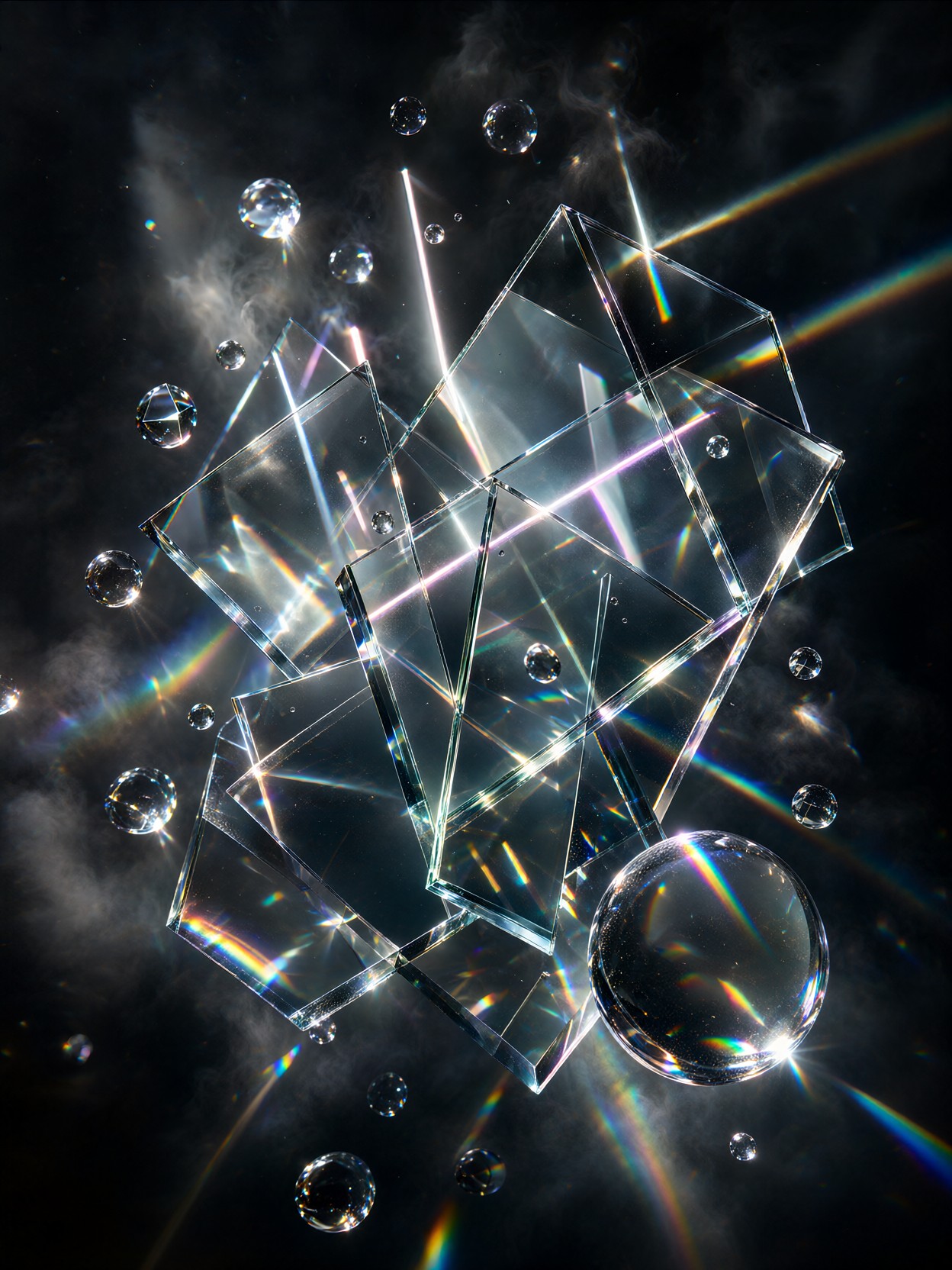
The moment crisp white beams meet soft pastel neon light, a chaotic yet beautiful physics experiment unfolds. This image is defined by the incredible interplay between hard, sharp architectural geometry—the glass prisms—and the utterly soft, ephemeral elements of the scene, like the dark smoke. Qwen 2.1 excels at rendering this level of detail, specifically mastering the interplay of light dispersion, caustics, and hyper-detailed glass refraction that makes the floating spheres feel truly three-dimensional.
The entire composition relies on the tension between the rigid, polished edges of the glass and the organic, undefined wisps of dark haze. Every tiny dust particle caught in a light ray is a testament to the model’s fine detail capabilities, turning a simple abstract scene into a monumental, photorealistic 3D render that seems to vibrate with reflected spectrum.
Where This Abstract Digital Art Finds Its Home
This level of intricate, high-fidelity abstraction is perfect for digital wallpaper, avant-garde album covers, and high-end conceptual art portfolios. If you are working in motion graphics or are designing environments for a sci-fi or high-fashion campaign, this output serves as a perfect textural foundation.
Because the composition is inherently dramatic, we recommend a 16:9 or 4:3 aspect ratio to maximize the depth of the void and allow the light beams to stretch across the frame. If used for social media, a square format (1:1) works well, provided the central geometric clusters are dominant.
Settings for Qwen 2.1 — Harnessing Detail and Contrast
As the newest model in the Qwen family, 2.1 is designed to handle complex visual information and lighting with ease. To ensure the glass doesn't turn into a blurry mess, you need to reinforce the prompt's technical demands.
- Guidance Scale: Try
5.0–6.0. While Qwen is smart, higher guidance helps it stick rigorously to the "hyper-detailed," "photorealistic," and "caustics" instructions without drifting into generic abstraction. - Steps: Use 30 steps. Given the extreme contrast and fine particle detail, more sampling steps will help render the dust particles and glass facets cleanly.
- Resolution: Since the model has native 2K output, aim for a resolution like
1664x928(16:9) or2048x1024(16:9) to best showcase the architectural scale.
The key to this prompt's success is the phrase "Hyper-detailed glass refraction." This is the instruction that forces the model to render surface physics rather than just shapes.
Five Creative Directions to Transform the Void
5 Targeted Variations for This Prompt
- Shift the Material: Replace "geometric glass prisms" with "molten obsidian shards." The mood shifts from delicate and fragile to dangerous and aggressive, trading soft pastels for sharp, oily black reflections.
- Color Intensification: Replace "soft pastel neon light" with "bioluminescent emerald and sapphire light." This shifts the environment from a gentle, hopeful aesthetic to a deep-space, alien sci-fi theme.
- Change the Environment: Swap "dark, hazy void" for "the interior of a massive, derelict Brutalist skyscraper." The abstract geometry becomes structural, grounding the image in a specific, man-made setting.
- Introduce Life: Add the modifier "a solitary, perfectly rendered clockwork automaton" amongst the spheres. The scene transitions from pure abstract physics into a steampunk or highly complex mechanical narrative.
- Introduce Action: Change "floating spheres" to "spheres undergoing a controlled micro-explosion of light." This adds dynamic energy and suggests a momentary event, making the image feel less like a static render and more like a captured moment.
Two Prompts Ready to Generate
We are applying two distinct variations—one shifting the palette to a deep sci-fi bioluminescence, and the other transforming the material from glass to volcanic rock.
Variation: Bioluminescent Sci-Fi — swapping pastel neon for deep, vibrant emerald and sapphire light to create an alien, high-contrast environment.
Realism, Abstract Architectural Geometry. High-angle shot of complex, layered geometric glass prisms and transparent floating spheres hovering inside a dark, hazy void. Beams of vibrant emerald and sapphire bioluminescent light pass through the glass, creating stunning color dispersion, caustics, and rainbow spectrum reflections on soft wisps of dark smoke. Hyper-detailed glass refraction, polished edges, surface dust particles caught in light rays, deep contrast, ultra-sharp focus, photorealistic 3D render, 8k.
Variation: Molten Obsidian — changing the material from fragile glass to sharp, dark, aggressive obsidian shards, intensifying the depth and contrast.
Realism, Abstract Architectural Geometry. High-angle shot of complex, layered molten obsidian shards and transparent floating spheres hovering inside a dark, hazy void. Beams of crisp white and soft pastel neon light pass through the obsidian, creating dramatic, high-contrast caustics and rainbow spectrum reflections on surrounding dark smoke. Hyper-detailed surface fracture, sharp edges, deep contrast, ultra-sharp focus, photorealistic 3D render, 8k.
More Abstract Geometric Concepts to Explore
If the visual complexity and lighting of this piece resonate with you, exploring other abstract interpretations of structure and light can lead to incredible results. Try mixing materials or environments into these concepts: