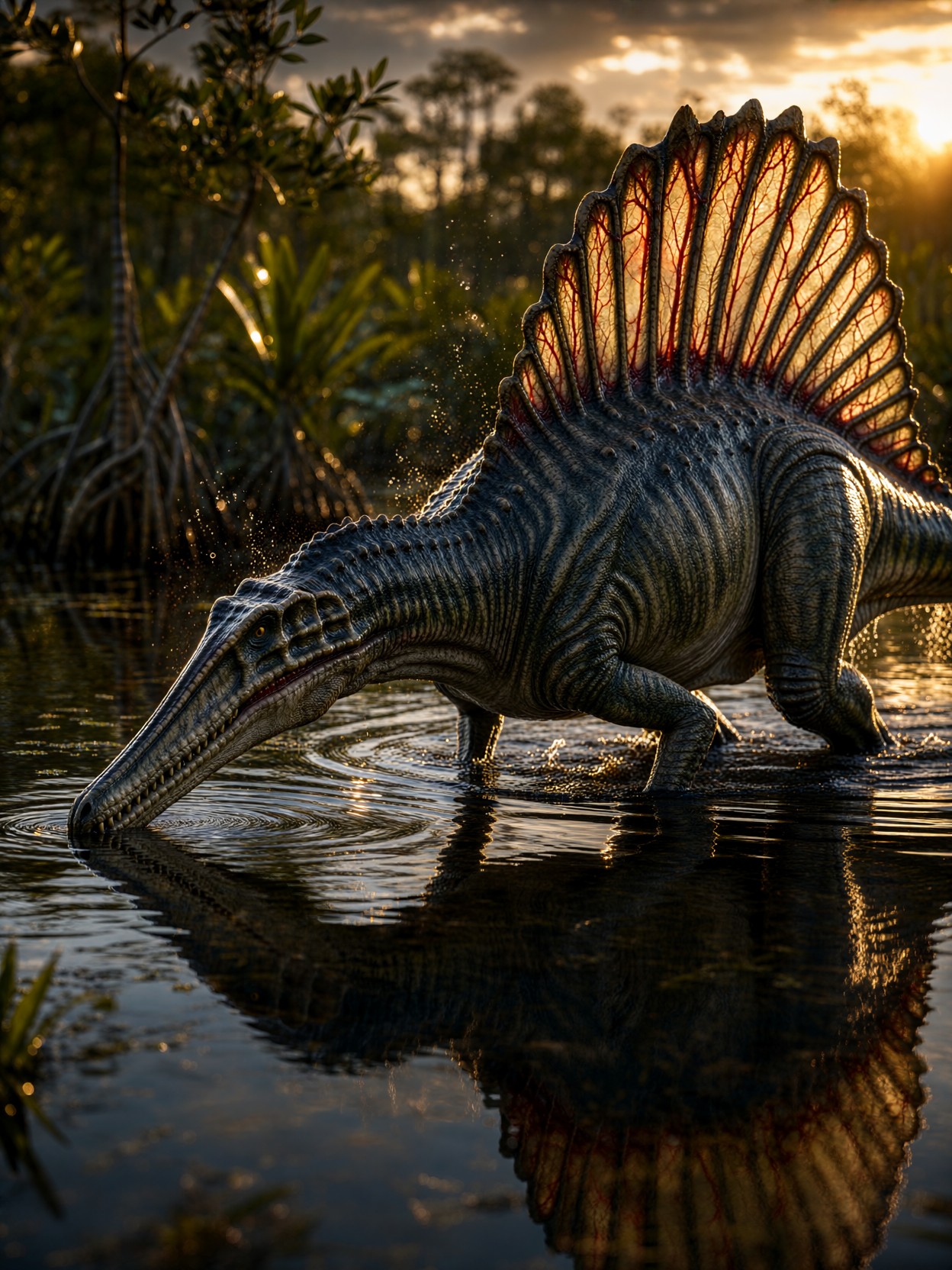

Translucent Sails and Mirror Water: Anatomy of a Prehistoric Wildlife Shot
Glowing blood vessels inside a Spinosaurus sail is the detail that sells this entire image — the moment sunlight hits that dorsal fin from behind, the dinosaur stops being a monster and becomes an animal. Qwen 2.1 handles this translucency beautifully at native 2K resolution, rendering the warm backlight as if the fin were a stained-glass panel of veins and weathered bone.
The rest of the composition earns its documentary credibility through restraint: a side-profile tracking angle, a crocodilian snout just breaking the mirror-like surface, ripples spreading in clean rings, and ancient mangrove flora dissolving into soft f/1.2 bokeh. Rim-lighting along the spine and scattered water droplets give the frame that Planet Earth energy — rich natural contrast without artificial drama.
Documentary Mockups, Museum Walls, and Cinematic Storyboards
Wildlife-documentary-style dinosaur renders are gold for prehistoric museum exhibits, natural history book covers, and paleo-art social channels — anywhere a "photograph that never existed" creates instant intrigue. The 16:9 cinematic framing also drops neatly into video thumbnails and storyboard panels for film pitches.
Stick to landscape: 1664×928 (16:9) preserves the tracking-shot feel and gives the bokeh background room to blur. Portrait crops will cramp the sail and kill the sense of an animal moving through space. Note that fine scale texture and water reflections are demanding — avoid ultra-low step counts or the wet-skin detail turns to mush.
Settings for Qwen 2.1 — Protecting the Reflections
Qwen 2.1 generates natively at 2K, so you can push resolution higher than most models without upscaling artifacts. Its lifelike lighting engine is the reason the rim-lighting and golden-hour glow read as photographed rather than rendered.
- CFG / Guidance:
3.0–3.5— high enough to hold the "shot on Leica SL2" camera language, low enough to keep highlights on the water from clipping - Steps: 30 for maximum quality — the translucent vessels and ripple detail need them; 12 only for composition previews
- Resolution:
1664×928(16:9 cinematic); go native 2K (2048×1152) for print or exhibition use
The camera-lens keywords ("50mm f/1.2", "Leica SL2") do real work here — Qwen 2.1 interprets them as optical instructions, so keep them even when trimming other words.
Using the GPT Style LoRA
- GPT style at
0.65— sits right at the edge of dominance: it adds a luminous, cinematic glow and slight mythic grandeur to the golden hour light without breaking photorealism - Drop to
0.40if the iridescent cast starts fighting the natural wildlife palette; push to0.75only if you want the scene leaning toward fantasy rather than documentary
At 65 weight, expect the bokeh highlights to gain a gilded warmth and the sail's translucency to intensify — a happy accident that suits this prompt perfectly.
Six Ways to Reshoot the Spinosaurus
6 Targeted Variations for This Prehistoric Tracking Shot
- Change the hour: Swap "golden hour" for "blue hour, mist rising off the water" — the sail stops glowing warm and becomes a cold silhouette, moodier and more ominous
- Add behaviour: Replace "snout touching the water" with " jaws clamped around a giant lungfish, water exploding outward" — instant action shot, raise steps to 30+ to hold the splash detail
- Shift the lens: Change "50mm f/1.2" to "600mm telephoto, compressed background" — the bokeh flattens, the animal feels observed from far away, classic safari-documentary framing
- Go underwater: Add "half-submerged view, split-shot above and below the waterline" — Qwen 2.1's clarity on reflections makes the split-level composition a showpiece
- Seasonal twist: Change "lush ancient flora" to "autumn cypress, floating amber leaves" — warm palette deepens, and the ripples carry drifting foliage
- Scale reference: Add "a flock of small pterosaurs taking flight in the background" — adds motion, depth layers, and a sense of the ecosystem
Two Prompts Ready to Generate
Both examples below apply variations from the list, tuned for Qwen 2.1 at the settings above — the second leans into the GPT style LoRA's glow at full 65 weight.
Variation: blue hour mood shift — the same tracking shot recast in cold mist, silhouette emphasis instead of warm rim-light
Wildlife documentary photo, side-profile tracking shot of a giant Spinosaurus wading through shallow mirror-like waters of a prehistoric mangrove swamp at blue hour, mist rising off the water, sail-like dorsal fin a cold dark silhouette against the fading light, long snout touching the surface creating gentle ripples, distant pterosaurs in the foggy background, shot on Leica SL2, 50mm f/1.2, rich natural contrast, photorealistic, 8k, 16:9
Variation: feeding action shot — jaws clamp a lungfish, splash detail replaces stillness, golden hour and GPT style glow retained
Realism, wildlife documentary style. Side-profile tracking shot of a giant Spinosaurus wading through shallow golden-hour waters of a prehistoric mangrove swamp, jaws clamped around a giant lungfish, water exploding outward in glowing droplets, translucent dorsal sail backlit by the setting sun showing glowing vessels, dramatic rim-lighting along its spine, lush ancient flora in soft bokeh, Leica SL2, 50mm f/1.2, photorealistic, 8k, cinematic 16:9
More Golden-Hour Realism to Explore
These prompts share the same natural-light documentary DNA — warm sun, candid subjects, and lens-aware realism that suits Qwen 2.1's strengths: