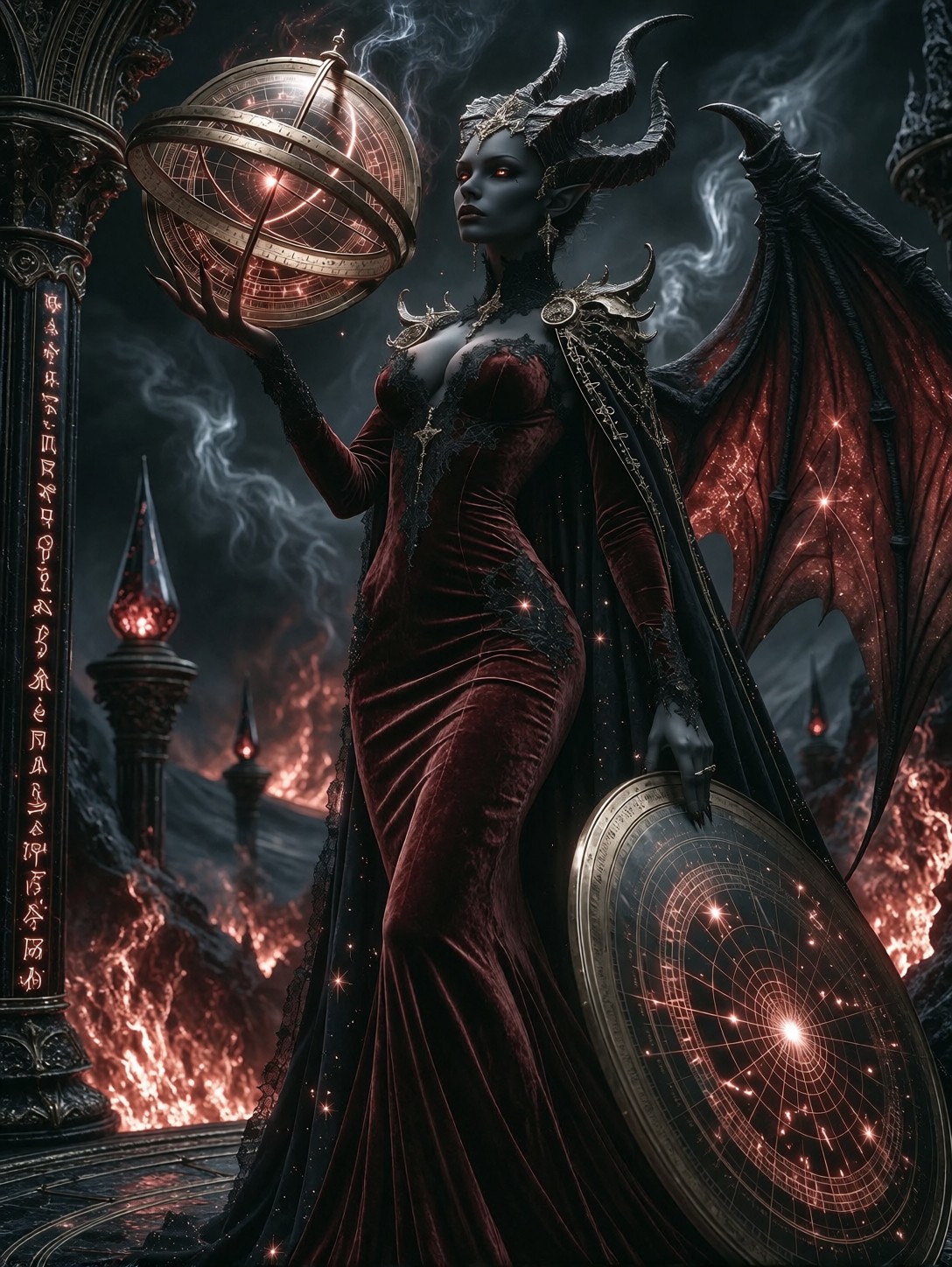


Mapping Doomed Souls: The Sublime Contrast of Hellish Astronomy
The moment the brass rings of the astrolabe begin to glow, charting constellations of fire and despair, the scene transcends simple dark fantasy. We are witnessing a collision between refined, elegant beauty—embodied by the succubus in ember-red velvet—and the cold, terrifying mechanics of the cosmos. Proxima Aurelia 2 excels at this kind of rich visual storytelling, allowing the model to treat the complex, glowing infernal glyph carvings on the obsidian columns with the same high-fidelity attention it gives the delicate folds of lace.
The low-angle medium shot combined with moody chiaroscuro lighting forces the viewer into the intimate space of the observatory terrace, feeling the weight of the smoky void sky above. This isn't just a portrait; it's a powerful statement on the intersection of knowledge, power, and the infernal. The dust motes catching the light are a subtle detail that brings the grand, ominous atmosphere to life. 😈
Conceptual Art for Epic Dark Narratives
If your projects involve deep, atmospheric lore, this prompt is a goldmine for concept art. Consider using this for dark fantasy novel covers, high-budget video game character design, or elaborate tabletop role-playing campaign backdrops. The sheer level of detail in the velvet texture and the glowing glyph detail makes it immediately marketable as high-end digital art.
Since the prompt is a medium shot focused on the subject's presence, maintaining the vertical orientation is key. A portrait aspect ratio will best capture the towering columns of volcanic glass and the dramatic sweep of the starry void.
Optimizing Proxima Aurelia 2 — Aesthetics and Storytelling
Proxima Aurelia 2 is designed to handle complex visual narratives, so we can push for high quality and rich detail without overwhelming the model with excessive negative prompting. The key is guiding the aesthetic while letting the model handle the composition.
- CFG / Guidance Scale: 4.5–6.0 — Since the prompt is highly detailed (glyphs, velvet, starlight), a moderate CFG helps ensure the model follows the specific lighting and object instructions without becoming too abstract.
- Steps: 30–40 — To render the fine details of the tarnished silver horns, the complex lace, and the glowing astrolabe rings, maximum steps are recommended.
- Resolution / Aspect Ratio: 2:3 or 9:16 — These vertical ratios best showcase the height of the obsidian terrace and the dramatic, low-angle perspective.
Integrating the LoRA Styles
This prompt is uniquely powerful because it utilizes two opposing LoRAs that balance each other perfectly. Think of it as "Beauty meets Brutality."
- Grimdark Tabletop Fantasy Style (60): This is your foundation. It locks in the necessary grit, the deep shadows, and the oppressive, atmospheric tone of the volcanic setting.
- GPT style (40): This acts as the 'uplift.' It takes the gritty chaos and introduces the necessary opulence—the luminous glow of the astrolabe, the iridescent quality of the crimson velvet, and the cinematic polish that makes the scene feel "breathtaking."
The combination works because Grimdark establishes the *mood*, and GPT establishes the *spectacle*.
Creative Prompt Variations for Experimentation
5 Targeted Variations to Push This Succubus Astronomer Further
- Shift the Focus to Action: Instead of "stands," change to "kneels at the edge of the terrace, peering through a massive brass refracting telescope." This changes the mood from observation to deep, secretive research.
- Alter the Subject's Origin: Replace "succubus" with "fallen celestial scholar" or "archangel trapped in infernal service." This adds a layer of tragic lore to the character's internal conflict.
- Change the Palette to Ice and Shadow: Replace "crimson and violet" with "glacier-blue and necrotic silver." This instantly shifts the setting from a fiery underworld to a frozen, cosmic abyss, demanding a completely different aesthetic.
- Introduce a Rival/Companion: Add a secondary figure, such as "a silent, obsidian gargoyle sentinel," or "a rival sorcerer in heavy baroque robes." This immediately adds narrative tension to the composition.
- Change the Setting to the Mundane: Replace "obsidian observatory terrace" with "the cluttered, dusty attic of a forgotten European clockmaker." This grounds the dark fantasy in a more grounded, 'found object' aesthetic, contrasting the cosmic scale with human intimacy.
Two Prompts Ready to Generate
These two examples demonstrate how swapping the color temperature and the setting can drastically redefine the entire narrative of the image.
Variation: Icy Cosmic Abyss — Shifting the color palette from fiery red/violet to cold blue/silver, transforming the underworld into a frozen, celestial landscape.
Dark Fantasy, a celestial scholar in an elegant floor-length gown of sapphire blue velvet and silver lace, stands on a crystalline observatory terrace. Her horns are crowned with frosted platinum. She holds a glowing brass astrolabe charting constellations of glacial blue and silver in a smoky void sky. Columns of carved ice flank her, etched with glowing cerulean glyph, distant nebula smoldering below. Moody chiaroscuro lighting, deep sapphire and charcoal palette, highly detailed, 8k.
Variation: The Mundane Attic — Replacing the grand terrace with a cluttered, dusty attic, focusing on a more intimate and grounded dark fantasy feel.
Dark Fantasy, an elegant adult succubus astronomer in an ember-red velvet gown, stands in a cluttered, dusty attic of a forgotten European house. She stands beside a huge wooden drafting table covered in star charts and brass tools. She holds an antique astrolabe, light spilling through a grimy arched window onto her black lace. Ominous yet refined atmosphere, dust motes visible in the light, cozy yet sinister, highly detailed, 8k.
More Art from This Dark Fantasy Collection
If you enjoyed the dramatic lighting and rich textures of this succubus astronomer, explore these related prompts to deepen your collection of gothic and mythological character art.