
Battle Scars in Golden Dust: Why This Triceratops Shot Feels Real
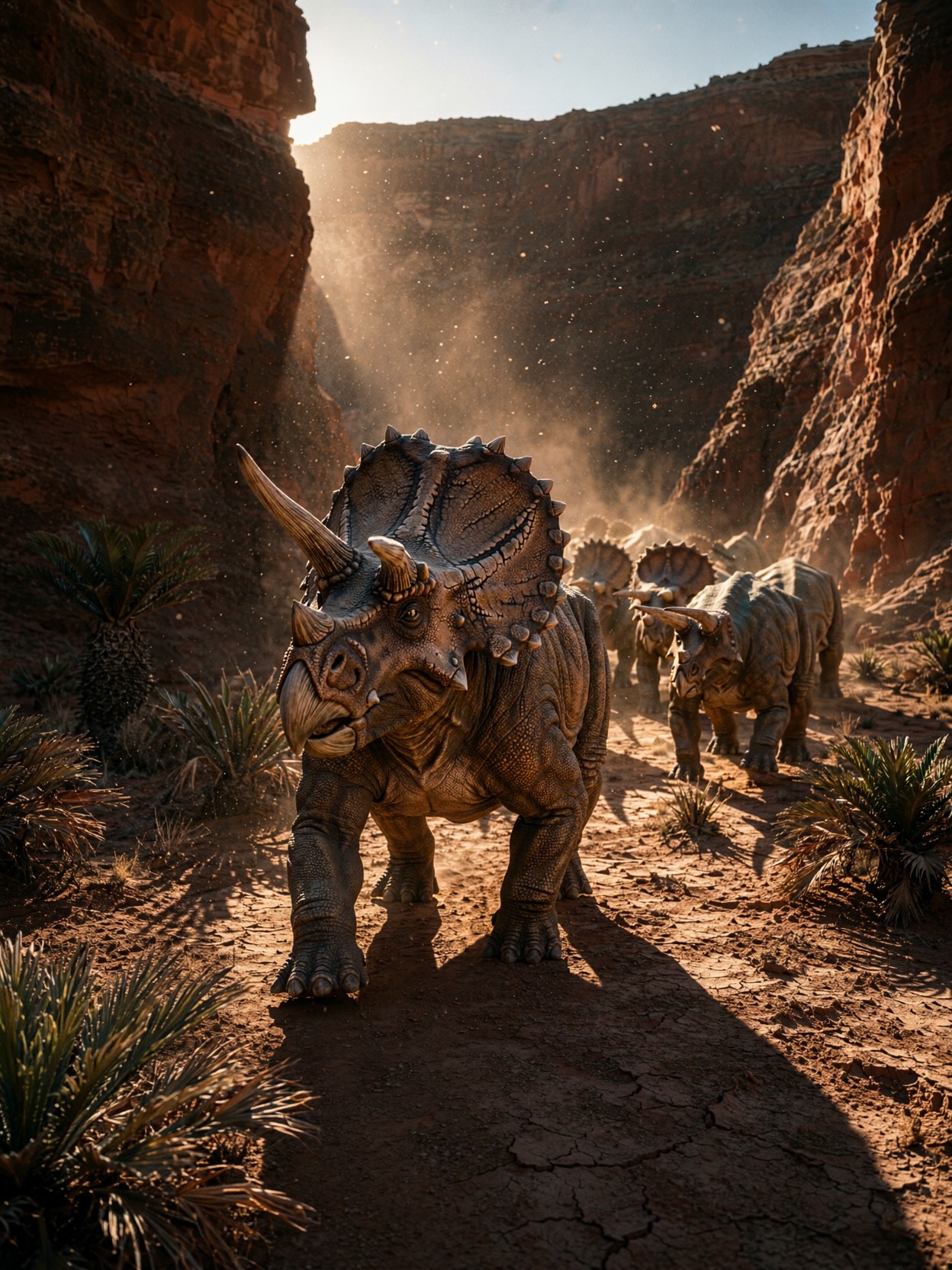
A battle-scarred horn crest catching the first light of sunrise — that single detail is what separates this prompt from generic dinosaur imagery. Qwen 2.1 handles the two hardest parts of this scene exceptionally well: the weathered skin texture with visible pores and cracked hide, and the golden light beams slicing through floating dust motes between red-rock walls.
The composition follows classic wildlife photography logic — a sharp, dominant lead subject in the foreground, the herd receding into hazy depth, long shadows stretching across cracked desert floor. The Hasselblad H6D-100c and 24mm f/2.8 references aren't decoration; camera language nudges the model toward wide-angle perspective distortion and natural film grain rather than a plastic, CGI look.
Documentary Posters, Museum Walls, and Book Covers
Anything that needs to read as "photograph, not render" benefits from this setup: paleontology exhibition prints, nature documentary key art, large-format wall decor, and prehistoric fiction book covers. The wide-angle 3:2 landscape framing suits desktop wallpapers and cinematic thumbnails best.
One limitation: this prompt is built for environmental scale. If you need a tight close-up for a portrait crop, the dust beams and canyon depth will fight the framing — generate a separate headshot-focused variant instead.
Settings for Qwen 2.1 — Native 2K and Fine Detail
Qwen 2.1's native 2K output and fine-detail strength make it a strong match for the hyper-detailed skin pores and rich dynamic range demands here. Its lifelike lighting handling also renders the low-contrast sunrise glow without over-brightening the sky.
- CFG / guidance:
3.5— keeps realism grounded; higher values push the skin toward waxy over-sharpening - Steps: 30 for maximum texture fidelity on hide and bone; 12 for fast composition previews
- Resolution:
1664×928(16:9 cinematic) or1920×1280(3:2) for print-ready width
Keep "natural film grain" in the prompt — Qwen 2.1 honors it, and it's the cheapest way to kill the sterile digital-render look in prehistoric scenes.
Using the GPT Style LoRA
GPT style at 0.65 sits in the interesting middle zone — dominant enough to add its gilded, cinematic glow and dreamlike scale, but below the 0.70+ threshold where it fully takes over the photorealistic base. Expect slightly amplified light beams and a subtle iridescent warmth in the dust.
If you want pure documentary realism, drop it to 0.30–0.40. If you want the herd to feel mythic — almost painted — push to 0.75 and add "epic mythic scale" to the prompt.
Six Ways to Push the Canyon Herd Further
6 Targeted Variations for This Prehistoric Landscape
- Storm instead of sunrise: Replace "sunrise golden light" with "approaching thunderstorm, dramatic shafts of rain-lit grey light" — the mood shifts from warm serenity to looming tension, and the dust becomes wet and heavy
- Close-up portrait: Change "wide-angle shot of a group" to "tight profile portrait of the lead Triceratops" — the battle scars and skin pores become the entire story; use 3:4 framing
- Add a threat: Insert "a distant T. rex silhouette on the canyon rim" — instantly adds narrative danger and gives the lead's wary head-turn a reason
- Seasonal shift: Change "dry and cracked" desert to "narrow canyon river, lush ferns after rare rain" — greener palette, reflections, and a completely different ecosystem mood
- Time of day flip: Swap sunrise for "blue hour twilight, herd lit by faint bioluminescent cycads" — leans into the GPT style LoRA's fantasy glow for a sci-fi prehistoric hybrid
- Aerial documentary: Add "high aerial drone perspective, herd seen from above casting long shadows" — turns the shot into a migration documentary frame, ideal for 16:9
Two Prompts Ready to Generate
Both examples below apply variations from the list above, tuned for Qwen 2.1 at the recommended settings.
Variation: added threat — a T. rex silhouette gives the lead's wary glance narrative weight while keeping the documentary realism intact
Realism, epic nature photography. Wide-angle shot of heavy Triceratops moving through a dusty red-rock canyon at sunrise, lead Triceratops in sharp foreground focus turning its battle-scarred horn crest warily toward a distant T. rex silhouette on the canyon rim, dust motes in golden light beams, cracked desert floor with sparse cycads, long dramatic shadows, Hasselblad H6D-100c, 24mm lens, natural film grain, hyper-detailed skin texture, photorealistic, 8k
Variation: blue hour fantasy flip — twilight plus bioluminescent cycads leans into the GPT style LoRA's glow for a mythic prehistoric night scene
Realism, epic nature photography. Wide-angle shot of a Triceratops herd in a red-rock canyon at blue hour twilight, faint teal bioluminescent glow from ancient cycads illuminating weathered skin and battle-scarred horn crests, dust motes drifting in cool ambient light, deep indigo shadows, dreamlike mythic scale, cinematic glow, Hasselblad H6D-100c, 24mm lens, natural film grain, hyper-detailed texture, photorealistic, 8k
More Landscapes and Wildlife in This Direction
These prompts explore similar terrain — dramatic natural light, wide environmental framing, and a single subject anchoring the scene: