
Rain on Ancient Scales: Why This T-Rex Prompt Reads Like a Real Photograph
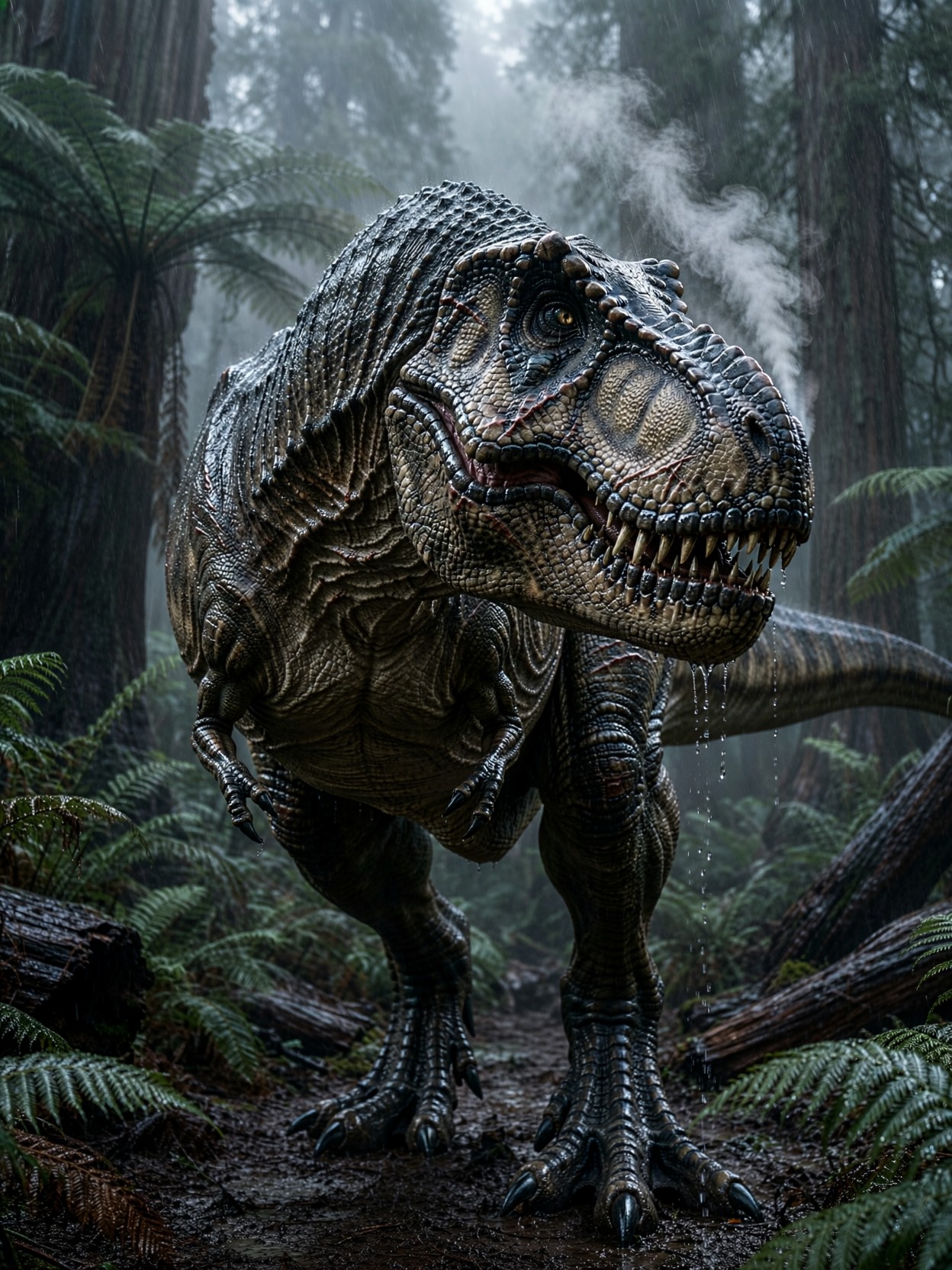
Steam curling from a Tyrannosaurus rex's nostrils into cold rain — that single detail is what separates this prompt from a hundred generic dinosaur renders. Qwen 2.1 responds strongly to physical cause-and-effect language: wet scales glisten because of the downpour, mist thickens because of the temperature contrast, and the low-angle medium shot makes the animal loom over the viewer like a genuine field photograph rather than a monster-movie poster.
The camera specification — Sony A1, 35mm f/1.4 — is not decoration. Naming real gear pushes the model toward documentary depth-of-field: sharp hide texture, softened fern background, visible rain streaks catching the dim daylight. Scars and rough hide texture give the model permission to break symmetry, which is where photorealism actually lives.
Documentary Mockups, Book Covers, and Museum-Style Displays
Natural-history book covers, paleo-art exhibitions, wildlife magazine mockups, and film pre-visualization boards all benefit from this "photographed, not painted" look. The National Geographic framing also makes it a strong candidate for educational thumbnails where credibility matters.
Stick to landscape orientation — 16:9 or 3:2 — so the fallen redwoods can frame the animal horizontally. Vertical crops squeeze the fog depth and flatten the sense of scale that the low angle creates.
Settings for Qwen 2.1 — Keeping the Realism Intact
Qwen 2.1's native 2K output and fine-detail strength are ideal here: rain streaks, individual droplets on the jaw, and wet mud are exactly the kind of micro-texture it resolves well. Keep guidance moderate so the atmosphere stays soft rather than over-sharpened.
- CFG / Guidance:
3.0–3.5— higher values harden the fog into artificial contrast - Steps: 30 for maximum hide and foliage detail; 12 for fast composition previews
- Resolution:
1664×928for cinematic 16:9, or2048×1152to exploit native 2K
A Word on the GPT Style LoRA
The attached GPT style LoRA at weight 1.00 is a celestial-fantasy look — gilded detail, iridescent color, mythic glow. At full strength it will fight the photorealistic intent of this prompt hard. For this image:
- Drop it to
0.15–0.25if you want only a faint luminous haze in the mist - Remove it entirely (
0) for pure documentary realism — recommended for the prompt as written - Keep it at
0.70+only if you deliberately pivot to a glowing, mythic dinosaur fantasy — a valid direction, just not this one
If your render comes out looking like a fantasy book cover instead of a wildlife photo, the LoRA is the culprit — dial it back before touching anything else.
Five Ways to Push the Prehistoric Rainforest Further
5 Targeted Variations for This T-Rex Prompt
- Golden hour shift: Replace "dim, moody daylight" with "low golden sunlight breaking through the storm clouds" — wet scales become amber mirrors and the mood turns majestic instead of ominous
- Closer and more menacing: Change "walking slowly" to "head lowered toward the camera, jaws slightly parted" — the 35mm lens at low angle becomes genuinely intimidating, ideal for a thriller poster
- Add a second subject: Insert "a small herd of triceratops frozen in the background mist" — introduces narrative tension and gives the fog a storytelling purpose
- Seasonal twist: Swap "heavy downpour" for "first snowfall settling on its scarred hide" — the steam from the nostrils becomes even more dramatic against cold air, and the palette flips to grey and white
- Night version: Change "dim, moody daylight" to "night, lit only by a researcher's flashlight beam through the rain" — turns the wildlife shot into found-footage horror
Two Prompts Ready to Generate
Both examples below apply variations from the list, tuned for Qwen 2.1 at cfg 3.5, 30 steps, landscape framing, and with the GPT style LoRA omitted for full realism.
Variation: golden hour shift — moody daylight replaced by storm-breaking sunlight, turning the wet hide into amber highlights
Realism, National Geographic wildlife photography. Low-angle medium shot of a massive Tyrannosaurus Rex walking slowly through a dense, foggy prehistoric fern forest during a heavy downpour, low golden sunlight breaking through storm clouds behind it. Thick dark-scaled skin glistening with rainwater, scars and rough hide texture, water dripping from its jaw, steam rising from nostrils. Massive fallen redwoods framing the scene, rain streaks, muddy forest floor. Shot on Sony A1, 35mm f/1.4, photorealistic, 8k.
Variation: night found-footage version — daylight swapped for a flashlight beam, converting the wildlife shot into tense horror atmosphere
Realism, documentary night photography. Low-angle medium shot of a massive Tyrannosaurus Rex standing motionless in a dense, foggy prehistoric fern forest during heavy rain at night, lit only by a researcher's flashlight beam cutting through the mist. Wet dark-scaled hide with scars, water dripping from its jaw, steam rising from nostrils into cold air. Giant ferns and fallen redwoods fading into darkness, rain streaks in the beam, muddy ground. Shot on Sony A1, 35mm f/1.4, photorealistic, 8k.
More Photorealistic Scene Prompts to Explore
These prompts share the same Qwen 2.1 strengths — lifelike lighting, fine material detail, and atmospheric depth — applied to very different subjects: