Dust, Scars, and a Low Horizon: Anatomy of This Lion Portrait
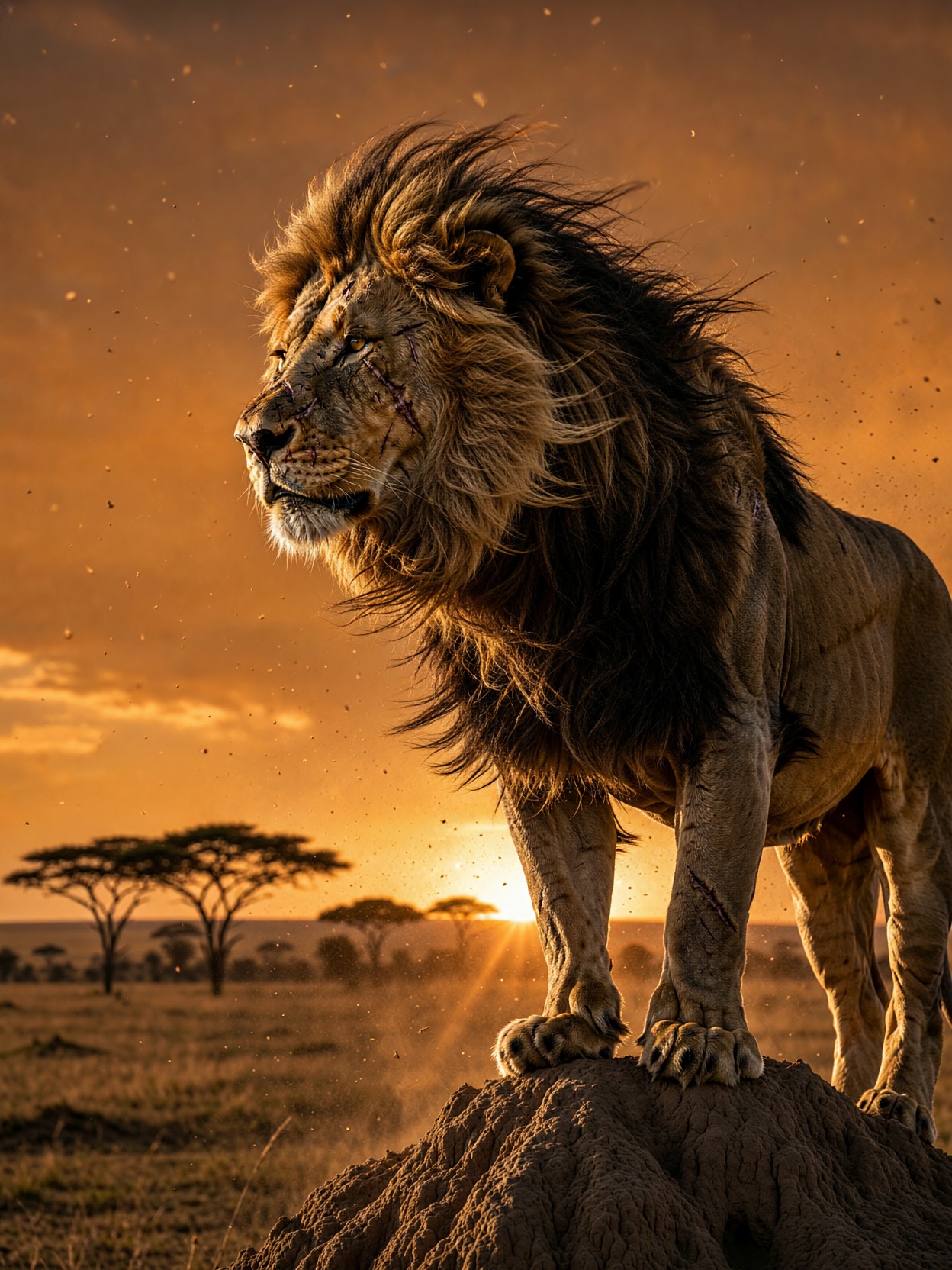
The low-angle side profile is what sells this image — placing the camera below the lion on the termite mound turns an old survivor into a monument, silhouetted mane against a deep orange sky. Qwen 2.1 handles the two hardest parts of wildlife realism here: backlit golden-hour dust particles (floating specular highlights that most models smear into haze) and the battle-scarred facial detail — visible scars, nose texture, skin pores — without softening them into generic fur.
The messy, wind-blown dark-brown mane gives the model organic chaos to work with, while the flat-top acacias on the horizon anchor the Serengeti geography. The Hasselblad H6D-100c and 85mm f/1.4 references aren't decoration: they push the model toward shallow depth of field, rich warm tones, and medium-format sharpness.
Wildlife Prints, Brand Campaigns, and Editorial Spreads
Epic wildlife photography like this is the backbone of safari tourism marketing, conservation fundraising materials, and premium wall art — a real Hasselblad safari shoot costs thousands; this costs a prompt. Editorial layouts, calendar covers, and wildlife book chapters are also strong fits.
Stick to a 3:4 or 4:5 portrait ratio — the low-angle vertical framing emphasizes the mound's height and keeps the sky-to-savannah balance intact. A 16:9 crop works for cinematic banners but flattens the monumental feel.
Qwen 2.1 Settings for Native 2K Wildlife Realism
Qwen 2.1's native 2K output means you can generate at full resolution without upscaling — a real advantage for the fine mane strands and dust bokeh this prompt depends on.
- CFG / Guidance:
3.5— keeps the warm sunset tones saturated without clipping the highlights around the sun - Steps: 30 for maximum quality; 12 works fine for composition previews
- Resolution:
1080×1440(3:4 portrait) or1440×1800for print-ready detail
Because Qwen 2.1 renders lifelike portrait lighting natively, resist the urge to add "dramatic rim light" to the prompt — the golden-hour description already produces it, and stacking both can double-light the mane unnaturally.
Five Ways to Push This Lion Further
5 Targeted Variations on the Battle-Scarred Lion
- Change the hour: Replace "sunset, deep orange sky" with "blue hour, first stars appearing" — the palette cools to indigo and silver, and the lion reads as a night hunter
- Shift the mood: Swap "standing proudly" for "roaring, mane thrown back, mouth open" — the serene monument becomes raw action, ideal for dynamic poster art
- Weather drama: Add "approaching storm, dark clouds gathering on the horizon" — the orange sky fractures into contrast, and the scars take on heavier symbolism
- Intimate reframing: Change the low-angle wide shot to "extreme close-up on the face, scars filling the frame, shallow depth of field" — loses the savannah, gains raw emotional detail
- Season twist: Replace "warm desert breeze, dust" with "after the rains, green grass, water droplets on the mane" — the Serengeti turns lush and the color palette shifts to emerald and gold
Two Prompts Ready to Generate
Both examples below apply variations from the list above, tuned for Qwen 2.1 at the recommended settings.
Variation: blue hour night hunter — the same low-angle composition shifted from sunset warmth to cold twilight drama
Realism, epic wildlife photography. Low-angle side-profile portrait of a battle-scarred old African lion atop a weathered termite mound in the Serengeti at blue hour, first stars appearing. Thick messy dark mane in the cool evening wind, scars across his broad nose, faint moonlight on silver-tipped fur, acacia silhouettes against a deep indigo sky. Hasselblad H6D-100c, 85mm f/1.4, ultra-detailed mane texture, photorealistic, 8k
Variation: extreme close-up — drops the wide savannah for an intimate scar-and-pore study with shallow depth of field
Realism, epic wildlife photography. Extreme close-up of a battle-scarred old African lion's face at sunset, scars filling the frame across his broad nose and brow, golden-hour light catching floating dust particles, intense amber eyes, thick messy dark-brown mane blurring at the edges, visible skin pores and whisker detail. Hasselblad H6D-100c, 85mm f/1.4, shallow depth of field, rich warm tones, photorealistic, 8k
More Golden-Hour Realism to Explore
These prompts chase the same warm, backlit realism from different subjects — water, neon, hangar light, and quiet indoor glow: