

Rain on Glass and Neon on Skin: Anatomy of a Car-Seat Noir Portrait
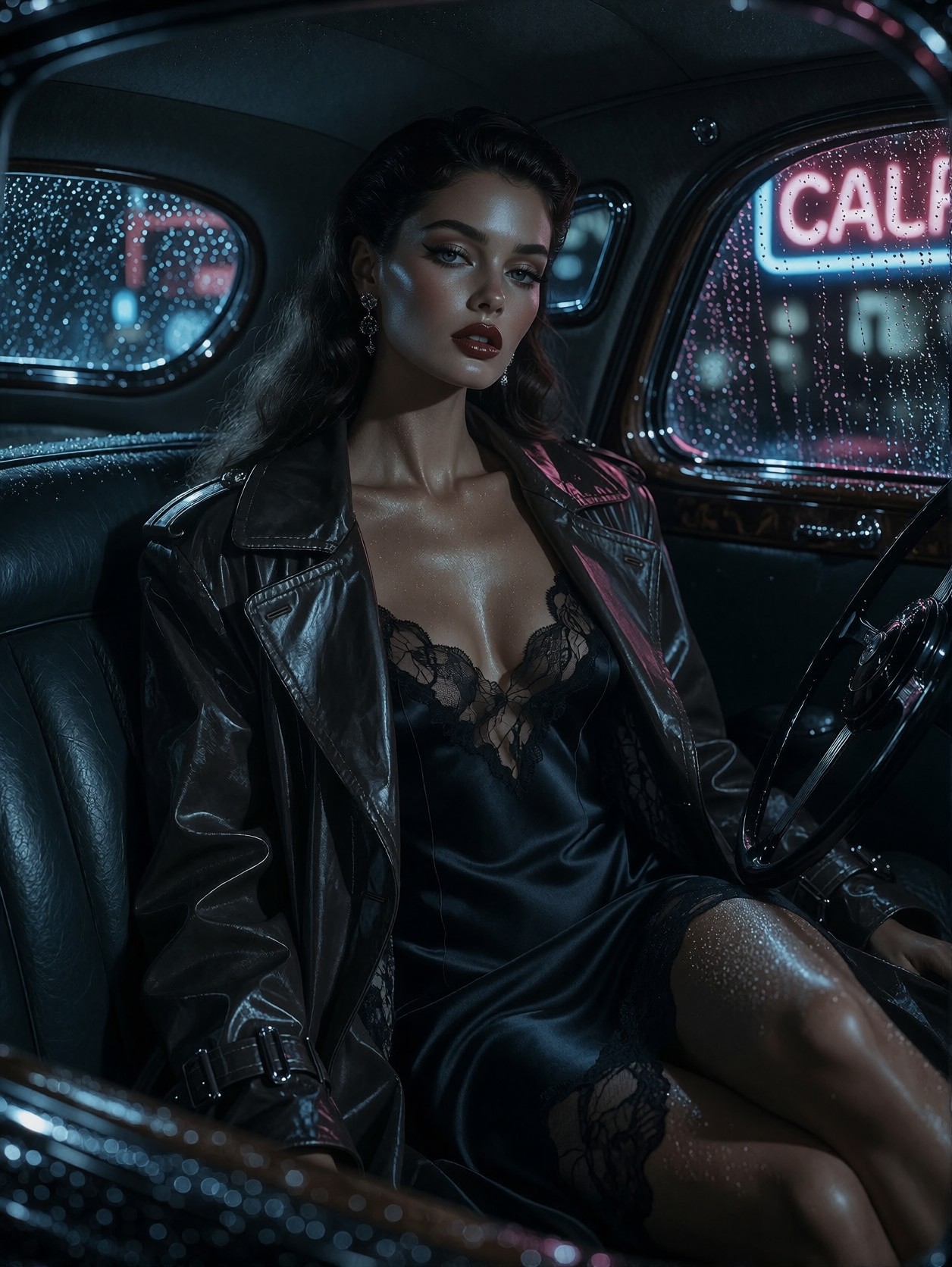
Rain-dappled glass is doing more work here than any single styling choice — it turns the entire frame into a lens with a mind of its own, breaking the neon reflections into soft bokeh veins across the composition. Proxima Aurelia 2 handles this layered depth exceptionally well: sharp lace-trimmed silk at the center, wet leather and glass distortion at the edges, all unified by the reflected pinks and cyans of an unseen night city.
The trench coat draped over the shoulders instead of worn is the storytelling detail — it reads as borrowed, temporary, cinematic. High-contrast shadows carve the face out of the dark, while vintage film grain keeps the whole thing feeling like a frame lifted from a 1940s print rather than a clean digital render.
Album Covers, Posters, and Narrative Key Art
Femme fatale imagery with genuine atmosphere is a constant commercial need: indie film posters, crime novel covers, jazz and synthwave album art, and character introductions for tabletop campaigns all live in this territory. The interior car framing also makes it a strong editorial choice — it implies a driver, a destination, a story just off-frame.
Stick to cinematic ratios: 1664×928 for widescreen framing, or 1080×1440 if you want a poster-style crop that emphasizes the subject over the window reflections. The prompt depends on foreground-to-background layering, so square crops tend to flatten it.
Settings for Proxima Aurelia 2 — Balancing Glow and Grit
Aurelia 2 builds rich storytelling from minimal prompting, which means restraint wins: it will amplify whatever mood words you give it, so avoid stacking too many style descriptors.
- CFG / Guidance:
3.0–3.5— enough to hold the high-contrast noir shadows without crushing the neon highlights into clipping - Steps: 30 for full film-grain and glass texture; 12 for fast composition previews
- Resolution:
1664×928(16:9) or1080×1440(3:4) depending on poster vs. cinematic use
If the neon reflections blow out to pure white, drop guidance to 3.0 before reducing steps — Aurelia 2 tends to over-deliver on glow words like "masterpiece" and "stunning."
Layering the LoRAs
- Dark Glamour 80s at
0.55— glossy makeup and shimmering highlights reinforce the wet-skin neon reflections; this weight sits right at the "clearly present but not dominant" line. Push to0.70for softer pastel tinting of the whole scene - GPT style at
0.55— adds cinematic glow and iridescent depth that flatters the reflected-light concept; keep at or below0.60, or the gilded fantasy tone will start fighting the 1940s grit
Together at equal weights they push the image toward lush, dreamlike noir — closer to Bullet Train than The Maltese Falcon. For harder-edged classic noir, drop both to 0.35 and let the film grain and contrast carry the mood.
Six Ways to Steer the Noir Scene Elsewhere
6 Targeted Variations for the Rain-Dappled Car Portrait
- Swap the era of the car: Change "classic 1940s luxury car" to "1962 Cadillac convertible, top down" — rain hits the subject directly, reflections double, and the mood shifts from claustrophobic to exposed
- Invert the palette: Replace "neon signs of a night city" with "warm amber streetlamps, gaslight" — the image moves from electric modern noir to gaslamp-era period piece, and the silk dress reads as Edwardian
- Change her role: Swap "sleek and elegant woman" for "weary detective, loosened tie, stubble" — the same seat, coat, and rain become a hard-boiled protagonist shot instead of a femme fatale
- Push the camera out: Add "view from the driver's seat, over-the-shoulder framing" — creates intimate tension and lets the dashboard and steering wheel frame her in the foreground
- Remove the rain: Change "rain-dappled glass" to "fog-frosted window, breath condensation" — softer, colder, more melancholic; the neon blooms instead of streaking
- Color-film noir: Replace "vintage film grain, high-contrast" with "Technicolor 1950s palette, saturated reds and teals" — keeps the composition but trades monochrome moodiness for mid-century Technicolor glamour
Two Prompts Ready to Generate
Both examples below apply variations from the list above, tuned for Aurelia 2 at guidance 3.0–3.5 with the two LoRAs at 0.55.
Variation: over-the-shoulder framing from the driver's seat — adds foreground tension and reframes the shot as an intimate two-person scene
Noir style, view from the driver's seat of a classic 1940s luxury car, a sleek elegant woman in the passenger seat seen through rain-dappled glass, lace-trimmed silk slip dress, dark trench coat draped over her shoulders, neon night city reflections on her skin and wet leather, dashboard and steering wheel framing the foreground, dark moody cinematic lighting, high-contrast shadows, vintage film grain, 16:9
Variation: Technicolor 1950s regrade — same composition and subject, but saturated color-film glamour replaces the monochrome noir mood
A sleek and elegant woman sitting in the passenger seat of a classic 1940s luxury car, seen through rain-dappled glass, lace-trimmed silk slip dress, oversized dark trench coat draped over her shoulders, saturated neon signs of a night city reflecting on her skin and wet leather interior, Technicolor 1950s palette, saturated reds and teals, cinematic glow, mid-century glamour, masterpiece
More Noir Atmosphere from the Same World
These prompts explore adjacent corners of rain-slicked, high-contrast glamour — nightclub smoke, art deco rooftops, and steampunk-laced velvet: