

Blind-Slat Light and a Voice You Can Almost Hear
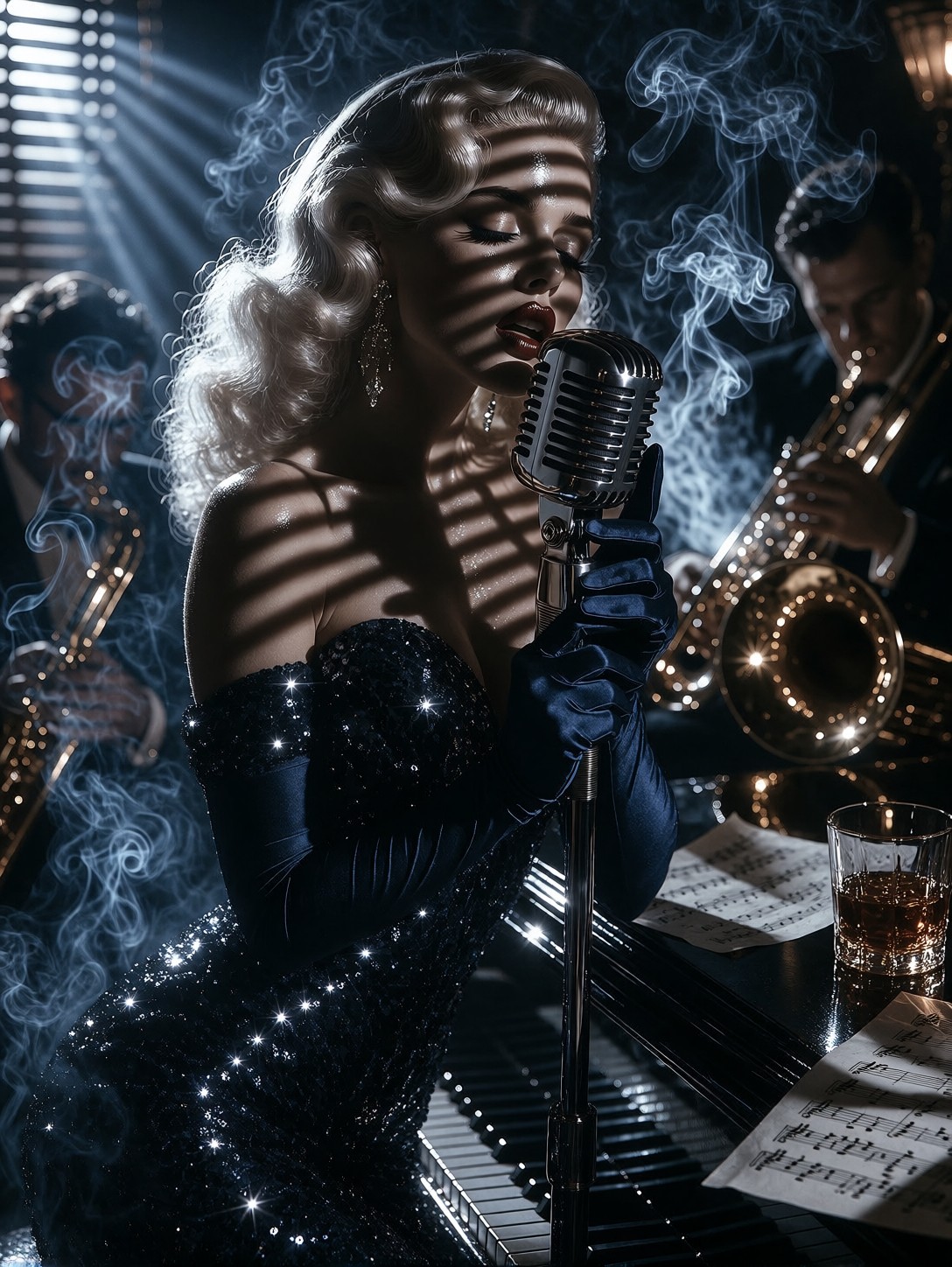
The venetian blind shadows are the whole engine here. Those hard black stripes across the face and bare shoulder turn a simple nightclub portrait into something sculptural — light as a physical object, slicing the gloom. Proxima Aurelia 2 reads this noir vocabulary fluently: it renders the wet-look sequins as scattered silver highlights, keeps the brass section a warm amber blur behind cigarette smoke, and nails the fatalistic half-lidded expression that makes the scene feel like a still from a lost 1940s film.
The low-key monochrome palette with charcoal blacks is what separates this from a generic jazz-club image — the model holds deep shadow detail instead of crushing everything to gray mush.
Album Covers, Posters, and Period Storytelling
Jazz album covers, theatrical posters, mystery novel jackets, and retro-themed editorial spreads are the natural homes for this image. The slight low angle gives the chanteuse presence without turning her into a caricature — ideal for anything that needs moody female-led noir iconography.
Stick with a 3:4 portrait ratio at 1080×1440. A wide landscape crop dilutes the intimate framing and lets the blurred background steal attention. If you need a banner, recompose rather than crop.
Dialing In Proxima Aurelia 2
Aurelia 2 builds rich storytelling from lean prompts, so resist over-stuffing the text — the LoRA stack is doing stylistic work the words don't need to repeat.
- Guidance:
3.5— keeps the blacks deep without flattening the silver highlight range - Steps: 12 for quick composition tests; 30 for final quality where the sequin micro-detail matters
- Resolution:
1080×1440for the standard portrait;1344×1792if the image is headed to print - Grain: the "heavy grain" instruction renders best at higher step counts — at 12 steps it can come out as noise rather than film texture
Reading the LoRA Stack Carefully
Three LoRAs here pull in different directions, so the weights matter more than usual:
- Surreal Dreamlike Style at
1.00is dominant — it supplies the soft atmospheric diffusion and quiet-mystery haze that actually flatters smoke-filled noir scenes - GPT style at
0.60adds gilded, iridescent cinematic glow — in monochrome this mostly manifests as richer silver highlights on the sequins and mic - Grim Dark Glamour 80s at
0.35contributes the shimmering-silver fashion-editorial finish on the gown
If the result drifts too dreamy and loses the hard blind-slat shadows, drop Surreal Dreamlike to 0.70 before touching anything else — that LoRA is what softens edges most.
Five Ways to Reshape This Noir Scene
Targeted Variations for the Chanteuse Prompt
- Swap the light source: Replace "venetian blind shadows" with "single bare bulb overhead, harsh downlight" — the mood shifts from cinematic noir to interrogation-room tension
- Introduce colour as betrayal: Add "a single red rose on the piano lid, the only colour in frame" — selective colour against monochrome is a classic noir storytelling device
- Change her fate: Swap "half-lidded eyes" for "glancing over her shoulder toward the door" — instantly injects narrative danger and a reason for the scene
- Move the era forward: Change "1940s nightclub" to "1960s lounge, sunburst wallpaper, tiki bar glow" — the palette loosens and the composition gains mid-century props
- Go wide: Add "wide shot from behind the audience, silhouetted heads in the foreground, 16:9" — trades intimacy for scale, ideal for a website hero image
Two Prompts Ready to Generate
Both examples below apply variations from the list above, tuned to the settings recommended for Aurelia 2.
Variation: selective colour storytelling — a single red object punctures the monochrome, adding the classic noir emotional stake
Film Noir. A lone chanteuse in a midnight-blue sequined gown at a chrome microphone in a smoky 1940s nightclub, half-lidded eyes, one gloved hand gripping the stand. Venetian blind shadows cut hard black stripes across her face. A single red rose on the piano lid, the only colour in frame. Blurred brass section glowing amber behind cigarette smoke, whiskey glass and sheet music nearby. Low-key monochrome, deep charcoal blacks, silver highlights, 50mm lens, slight low angle, shallow depth of field, heavy grain, high contrast, moody fatalistic atmosphere, 8k
Variation: narrative danger — the gaze turns toward the door, converting a mood piece into a story with a threat just off-frame
Film Noir. A lone chanteuse in a midnight-blue sequined gown at a chrome microphone in a smoke-hazed 1940s nightclub, glancing over her shoulder toward the door as if she heard it open, one gloved hand gripping the stand. Venetian blind shadows slice hard black stripes across her face and bare shoulder, slats of pale light in the gloom. Blurred brass section glowing dim amber through cigarette smoke, whiskey glass and scattered sheet music on the piano lid. Low-key monochrome, charcoal blacks, silver highlights on wet-look sequins, 50mm lens, slight low angle, shallow depth of field, heavy grain, tense fatalistic atmosphere, 8k
More Noir and Rain-Slicked Scenes
If smoke and shadow are your territory, these prompts explore the same hard-light, low-key mood from different subjects and cities: